If you’ve ever found yourself confused between tieing vs tying, you’re not alone. Many English learners and even native speakers hesitate when writing this word because both spellings look like they could be correct. But only one spelling is actually standard in modern English.
In this guide, you’ll learn the correct spelling, why the confusion happens, examples, common mistakes, and tips to remember the difference easily. By the end, you’ll never mix up tieing and tying again.
Quick Answer
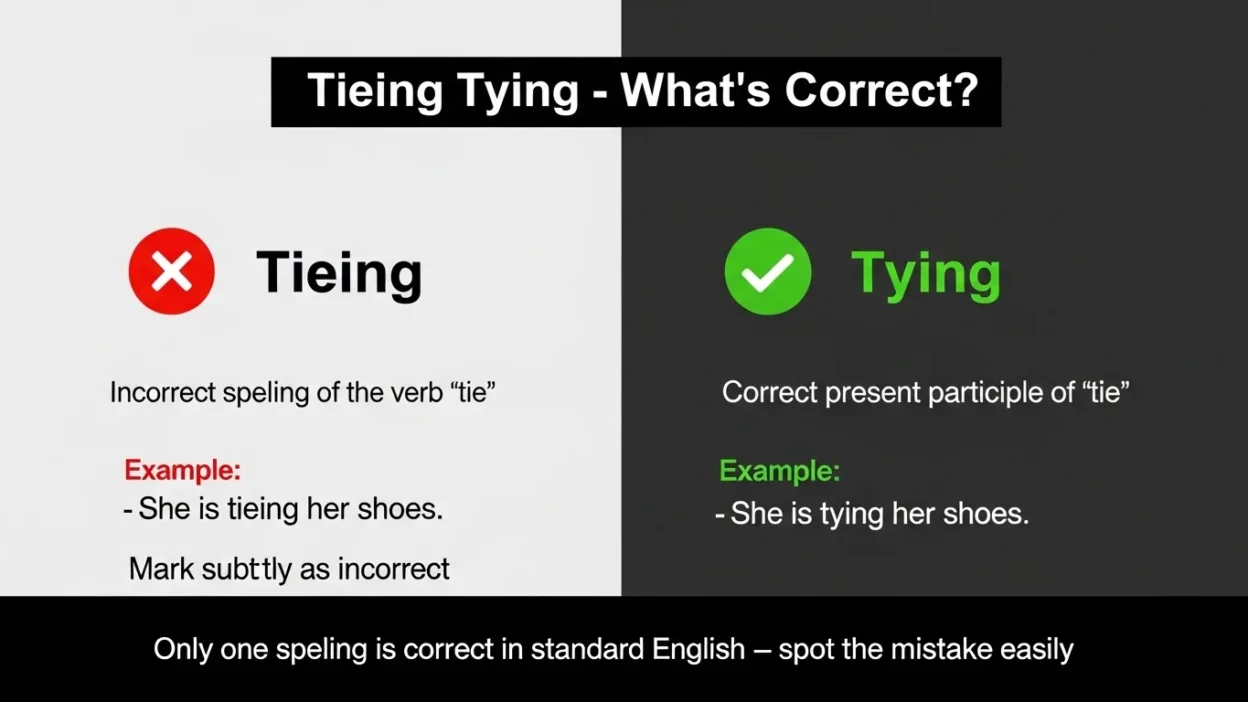
The correct spelling is “tying.”
“Tieing” is incorrect in standard English and should be avoided in formal and informal writing.
| Word | Correct or Incorrect | Example |
| Tying | ✅ Correct | She is tying her shoes. |
| Tieing | ❌ Incorrect | She is tieing her shoes. |
Understanding Tieing vs Tying
The confusion between tieing vs tying comes from how English verbs change when adding -ing. Normally, we just add -ing to a verb:
- Play → Playing
- Jump → Jumping
- Read → Reading
But verbs that end in -ie follow a special rule. When a verb ends in -ie, the -ie changes to -y before adding -ing.
Rule:
-ie → y + ing
Examples:
- Tie → Tying
- Die → Dying
- Lie → Lying
This is why tieing is incorrect and tying is correct.
What Does “Tying” Mean?
Tying is the present participle form of the verb tie, which means:
- To fasten something with a knot
- To attach or secure something
- To connect or link things together
- To finish in a draw (in sports)
Example Sentences:
- He is tying his shoelaces.
- She is tying a ribbon on the gift.
- The game is tying at 2–2.
- They are tying the rope to the pole.
Why Do People Write “Tieing”?
People write tieing because they apply the regular +ing rule and forget the -ie → y spelling rule. Since “tie” ends with “e”, many assume the spelling should be tie + ing = tieing, but English spelling rules change the word to make pronunciation easier.
Think of it this way:
- Tieing = looks logical
- Tying = grammatically correct
Tieing vs Tying Comparison Table
| Feature | Tieing | Tying |
| Correct spelling | ❌ No | ✅ Yes |
| Grammar rule | Incorrect | Follows -ie → y rule |
| Used in modern English | No | Yes |
| Dictionary accepted | No | Yes |
| Example sentence | Incorrect | Correct |
Common Mistakes to Avoid
Here are some common mistakes people make when using tying:
Mistake 1: Writing Tieing
❌ She is tieing her hair.
✅ She is tying her hair.
Mistake 2: Forgetting the -ie Rule
❌ Dieing → ✅ Dying
❌ Lieing → ✅ Lying
❌ Tieing → ✅ Tying
Mistake 3: Mixing Up With “Tie”
Remember:
- Tie = base verb
- Tying = present participle
- Tied = past tense
Examples:
- I tie my shoes every morning.
- I am tying my shoes.
- Yesterday, I tied my shoes.
American vs British English
Good news: There is no difference between American and British English for this word.
Both American English and British English use “tying” as the correct spelling.
| Version | Correct Spelling |
| American English | Tying |
| British English | Tying |
So no matter where you are writing US, UK, Canada, or Australia tying is always correct.
Tips to Remember the Correct Spelling
Here are some easy memory tricks so you never forget:
Trick 1:
If a verb ends in -ie, change it to -y before adding -ing.
- Tie → Tying
- Die → Dying
- Lie → Lying
Trick 2:
Remember this sentence:
“When -ie meets -ing, it becomes -y.”
Trick 3:
Think:
Tie → Ty → Tying
Short, simple, and easy to remember.
More Example Sentences Using “Tying”
- She is tying a knot in the rope.
- He is tying his tie in the mirror.
- They are tying balloons for the party.
- The team is tying the match.
- I am tying the package with string.
FAQs
1. Is tieing ever correct?
No, tieing is not correct in standard English. The correct spelling is tying.
2. Why is tying spelled with a Y?
Because verbs ending in -ie change to -y before adding -ing.
3. Is tying the present tense?
No, tying is the present participle or continuous form.
Example: She is tying her shoes.
4. What is the past tense of tie?
The past tense of tie is tied.
5. Do British people write tieing?
No, British English also uses tying.
6. What are similar words to tying?
Similar -ie → y words:
- Dying
- Lying
- Trying (from try, different rule but similar spelling style)
7. How can I remember tying vs tieing?
Just remember:
-ie verbs change to -y before adding -ing.
8. Is tying used in sports?
Yes. Example:
The teams are tying 3–3.
Summary
Understanding the difference between tieing vs tying is actually very simple once you learn the spelling rule. The correct spelling is tying, because verbs that end in -ie change to -y before adding -ing. That’s why we write tying, dying, and lying, not tieing, dieing, or lieing.
Many people make this mistake because English spelling rules can be confusing, but this is a common grammar pattern. Once you remember the -ie → y rule, you’ll be able to spell these words correctly every time without guessing.
Actionable Takeaway
Here’s the easiest way to remember the difference:
- If a verb ends in -ie, change it to -y and then add -ing.
- Tie → Tying
- Die → Dying
- Lie → Lying
Final tip:
If you ever write tieing, stop and check the correct spelling is almost certainly tying.

Ethan William is the author behind SpellPeak, passionate about clear communication and meaningful language. He writes to help readers express ideas with confidence, simplicity, and impact. His work focuses on clarity, learning, and empowering individuals and businesses through thoughtful, practical content. He values creativity, consistency, and ethical digital publishing worldwide.