If you have ever typed stary vs starry and wondered which one is actually correct, you are not alone. These two words look similar, sound close, and can easily confuse writers, students, and even native English speakers. The good news is that the difference is simple once you see how each word is used.
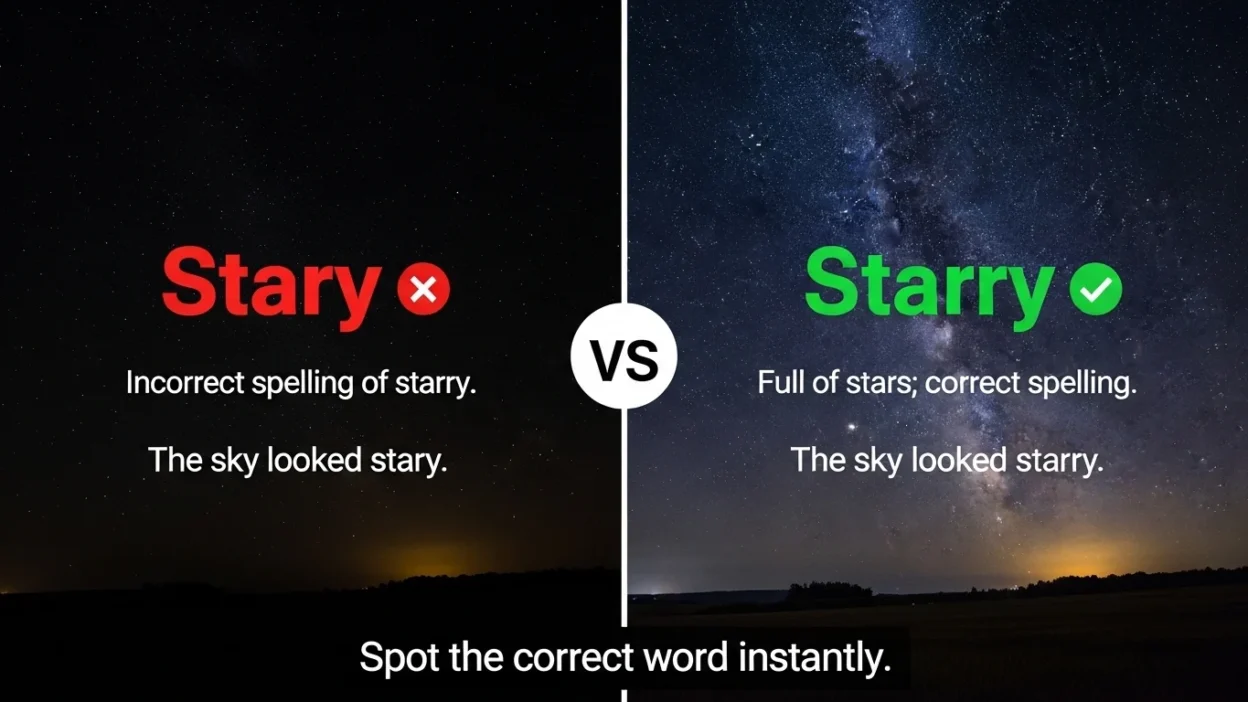
In most everyday writing, starry is the correct and standard spelling when you want to describe something full of stars or related to stars. Stary is much less common and is usually seen as a rare, technical, regional, or mistaken spelling in modern English.
This guide will help you understand the meanings, examples, common mistakes, and the correct choice for clear writing.
Quick Answer
- Starry is the standard and widely accepted spelling in modern English.
- Stary is rare and usually considered incorrect in general writing.
- Use starry for phrases like starry night, starry sky, or starry-eyed.
- In both American English and British English, starry is the preferred form.
What Does Starry Mean?
Starry is an adjective. It means:
- Full of stars
- Resembling stars
- Related to stars
- Dreamy or idealistic in expressions like starry-eyed
This is the word you will almost always need in normal English writing.
Examples of starry in a sentence
- We sat outside under a starry sky.
- The desert looked magical on a starry night.
- She gazed into the starry darkness above.
- He was starry-eyed about moving to Hollywood.
In all these examples, starry sounds natural and correct because it follows standard English spelling patterns.
What Does Stary Mean?
Stary is not the usual spelling in standard modern English. In most cases, people who write stary actually mean starry. That is why many spell-check tools flag it.
Still, stary may appear in a few rare situations:
- As a misspelling of starry
- As a surname or proper noun
- In non-English languages, where it may have a different meaning
- In very uncommon or outdated usage
For general English articles, blog posts, essays, emails, and social media captions, stary is usually not the correct choice.
Stary vs Starry: Main Difference
The main difference is simple:
| Word | Meaning | Common in Modern English? | Correct for General Writing? |
| Starry | Full of stars; relating to stars | Yes | Yes |
| Stary | Rare, nonstandard, or misspelling in most contexts | No | Usually no |
So when comparing stary vs starry, the safer and correct choice is almost always starry.
Why Is Starry Spelled with Double R?
Many learners wonder why starry has two r letters. The reason comes from how English forms adjectives from nouns.
The word star becomes starry by adding the suffix -y. When this happens, the spelling keeps the base word sound smooth and natural in standard English usage, giving us starry instead of stary.
This pattern is similar to other descriptive words in English where spelling changes help pronunciation and readability.
Common Phrases with Starry
You will often see starry in these popular expressions:
- starry night
- starry sky
- starry heavens
- starry-eyed
- starry landscape
- starry glow
These phrases are common in poetry, storytelling, travel writing, and everyday descriptions of the night sky.
Example sentences
- The children pointed up at the starry sky.
- We drove through the countryside on a calm starry night.
- Her writing creates vivid images of starry heavens.
- He sounded starry-eyed when he talked about fame.
Common Mistakes People Make
When writing about stary vs starry, here are the most common mistakes people make:
- Writing stary night instead of starry night
- Assuming both spellings are equally correct
- Using stary because it looks simpler
- Confusing typing errors with accepted spelling
- Believing one spelling is American and the other is British
The truth is that starry is the standard spelling across major varieties of English.
American vs British English
There is no meaningful difference between American English and British English here. Both prefer starry.
Correct in American English
- a starry sky
- a starry evening
- starry-eyed dreamers
Correct in British English
- a starry sky
- a starry night
- starry-eyed youth
So if you were hoping that stary might be the British version, it is not. Starry is standard in both.
When Should You Use Starry?
Use starry when you want to describe:
- The night sky
- Space-themed imagery
- A dreamy or romantic mood
- Someone who seems idealistic or fascinated
Good examples
- The lake reflected the starry sky beautifully.
- They enjoyed a peaceful walk beneath the starry heavens.
- She had a starry-eyed belief in success.
When Might You See Stary?
You may come across stary in these cases:
- Typing mistakes online
- Usernames or brand names
- Family names
- Words from other languages
But in standard English grammar and spelling, stary is not the normal choice for describing a sky full of stars.
Easy Trick to Remember the Difference
A simple memory trick is this:
Starry has more stars, so it has more letters.
Since starry describes something filled with stars, the extra r helps remind you that it is the fuller, correct spelling.
This small trick can help you avoid the mistake in exams, articles, and daily writing.
Stary vs Starry in Real Writing
If you are writing any of the following, choose starry:
- Blog posts
- School essays
- SEO articles
- Storytelling
- Poetry
- Product descriptions
- Social media captions
Correct examples
- We camped beneath a starry sky.
- The painting shows a starry evening in the mountains.
- Her eyes were starry-eyed with excitement.
Incorrect or nonstandard example
- We camped beneath a stary sky.
That version will usually look wrong to readers and search engines alike.
Is Stary Ever Correct?
In very limited contexts, yes, but not in the way most people mean it.
For example, Stary could be:
- A surname
- A place name
- A word from another language
But if your topic is the English adjective for a sky filled with stars, then starry is the right word.
FAQs
Is starry the correct spelling?
Yes, starry is the correct spelling in standard modern English when describing something full of stars.
Is stary a real word?
It may appear in rare cases such as names or non-English words, but in everyday English writing it is usually treated as a misspelling of starry.
What is the difference between stary and starry?
Starry is the accepted English adjective. Stary is rare and usually not correct in general writing.
How do you spell starry night?
The correct phrase is starry night, with a double r.
Is stary used in British English?
No, British English also uses starry as the standard spelling.
Why do people write stary?
Most people write stary by mistake because they assume the simpler spelling is right or they type too quickly.
Is starry-eyed related to starry?
Yes, starry-eyed comes from starry and describes someone who is dreamy, hopeful, or idealistic.
Should I ever use stary in an article?
Only if it is part of a name, quote, or special context. Otherwise, use starry.
Summary
The answer to stary vs starry is clear: starry is the standard, correct spelling in modern English. It is the word you should use for phrases like starry sky, starry night, and starry-eyed. Meanwhile, stary is rare and usually a misspelling in normal writing.
To keep your writing polished and professional, choose starry in almost every general context. This will improve clarity, avoid spelling mistakes, and help your content look more trustworthy to readers and search engines. When in doubt, remember this: if it is full of stars, it is almost certainly starry.
Actionable takeaway:
Before publishing anything, search your draft for stary and replace it with starry unless it is part of a name or special reference.

Matthew Benjamin is a contributing author at SpellPeak, dedicated to clear, engaging, and purposeful writing. He focuses on creating informative content that helps readers understand complex ideas with ease. His work emphasizes accuracy, creativity, and practical value, supporting better communication and thoughtful digital learning for a global audience.