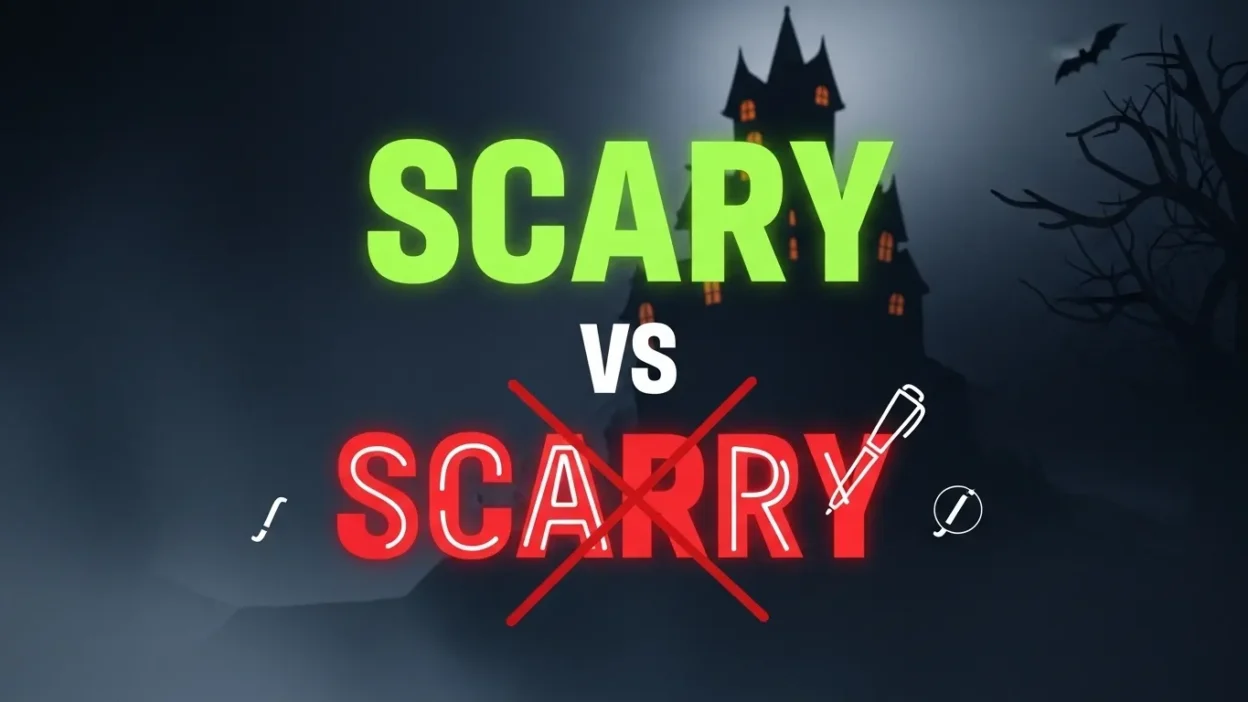
Have you ever paused mid-sentence, unsure whether to write scary or scarry? You’re not alone. This tiny spelling confusion trips up students, professionals, and even native English speakers. One extra letter can quietly turn correct writing into a noticeable mistake.
If you want to write clearly, confidently, and correctly, understanding the difference between scary vs scarry is essential.
In this complete guide, you’ll learn the correct spelling, why the confusion happens, examples in context, common mistakes, and helpful memory tricks so you never second-guess yourself again.
Quick Answer:
The correct spelling is “scary.”
“Scarry” is a misspelling and is not recognized as a correct English word.
- ✅ The movie was scary.
- ❌ The movie was scarry.
No matter whether you’re writing in American English or British English, “scary” is always correct.
What Does “Scary” Mean?
The word scary is an adjective. It describes something that causes fear, fright, or nervousness.
Definition of Scary:
Something that is frightening, alarming, or intimidating.
Examples:
- That haunted house was really scary.
- The thunderstorm sounded scary last night.
- Starting a new job can feel scary.
- The roller coaster looked scary, but it was fun.
“Scary” can describe both real dangers (like a wild animal) and emotional experiences (like public speaking).
Synonyms of Scary:
Using related words helps expand vocabulary and improve writing quality:
- Frightening
- Terrifying
- Spooky
- Creepy
- Chilling
- Horrifying
- Alarming
- Intimidating
These LSI keywords and related phrases help your writing sound more natural and expressive.
Is “Scarry” Ever Correct?
No. “Scarry” is not a correct English word.
It does not appear in dictionaries and is considered a spelling error. If you use “scarry” in formal writing, emails, academic essays, or professional communication, it may reduce credibility.
Spell-check tools usually underline “scarry” in red because it’s not valid.
Why Do People Confuse Scary vs Scarry?
Great question. The confusion typically happens for three main reasons:
1. Double Consonant Confusion
Many English words double the final consonant when adding a suffix:
- Run → Running
- Big → Bigger
- Sad → Saddest
This pattern makes some people assume that “scar” becomes “scarry.” But that’s not how this word works.
2. Confusion With “Carry”
The word carry has a double “r.” Because it sounds similar to “scary,” people mistakenly apply the same spelling rule.
- Carry → Carries
- Scary → Scariest (only one “r”)
3. Phonetic Spelling Mistakes
English pronunciation doesn’t always match spelling perfectly. Since “scary” sounds like it could have two r’s, some people accidentally write “scarry.”
Understanding the Root Word
The word scary comes from the noun scare.
- Scare (verb) → To frighten someone
- Scary (adjective) → Causing fear
When forming adjectives from verbs like this, we usually add “-y”:
- Cloud → Cloudy
- Noise → Noisy
- Scare → Scary
Notice that we drop the silent “e” and add “y.” We do not double the “r.”
So:
Scare → Scary ✅
Scar → Scarry ❌ (incorrect formation)
Scary vs Scarry: Comparison Table
Here’s a clear side-by-side comparison to make things simple:
| Feature | Scary | Scarry |
| Correct spelling | ✅ Yes | ❌ No |
| Dictionary recognized | Yes | No |
| Part of speech | Adjective | Not a word |
| Meaning | Causing fear | None |
| Used in American English | Yes | No |
| Used in British English | Yes | No |
As you can see, there is no situation where “scarry” is correct.
American vs British English: Any Difference?
When comparing scary vs scarry, there is no difference between American and British English.
Some words change spelling between the two versions of English:
- Color (US) / Colour (UK)
- Favorite (US) / Favourite (UK)
- Traveling (US) / Travelling (UK)
But “scary” is spelled the same in both American and British English. There is never a version with two “r” letters.
Common Mistakes to Avoid
Let’s look at some frequent errors and how to fix them.
❌ Mistake 1: Adding an Extra “R”
Wrong: That story was scarry.
Right: That story was scary.
❌ Mistake 2: Mixing Up “Scar” and “Scare”
- A scar is a mark left on skin.
- To scare means to frighten someone.
Example:
- He has a scar on his arm. (Correct)
- That noise will scare the baby. (Correct)
- That noise is scarry. (Incorrect)
❌ Mistake 3: Incorrect Comparative Forms
Wrong: More scarry
Right: Scarier
Correct forms:
- Scary
- Scarier
- Scariest
Notice again: only one “r.”
Memory Trick to Remember the Correct Spelling
Here’s a simple trick:
“Scary comes from scare — and scare has only one ‘r’.”
If you remember the base word “scare,” you’ll automatically avoid adding an extra “r.”
Another helpful tip:
If spell-check underlines it, trust the dictionary. “Scarry” will always be flagged.
More Example Sentences Using “Scary”
To build confidence, here are additional examples:
- The horror movie was too scary for kids.
- It’s scary how fast technology is changing.
- Walking alone at night can feel scary.
- The test results were scary at first.
- That abandoned house looks scary from outside.
Notice that “scary” can describe emotional reactions, dangerous situations, or even surprising facts.
FAQs
1. Is “scarry” ever a correct spelling?
No. “Scarry” is always incorrect in standard English.
2. Why do people spell scary with two r’s?
It’s usually due to confusion with words like “carry” or misunderstanding spelling patterns.
3. How do you spell scary in British English?
It’s spelled “scary” — exactly the same as in American English.
4. What is the comparative form of scary?
The correct comparative form is “scarier.” The superlative form is “scariest.”
5. Is scary an adjective or adverb?
“Scary” is an adjective. It describes something that causes fear.
6. What is the noun form of scary?
The noun form related to scary is “fear” or “fright.” The verb form is “scare.”
7. Can scary describe emotional experiences?
Yes. It can describe feelings like anxiety, nervousness, or intimidation.
8. Is “scary” informal or formal?
It’s neutral and appropriate in both casual and formal contexts, depending on usage.
Why Correct Spelling Matters
Spelling mistakes might seem small, but they can affect credibility. Whether you’re writing:
- Blog posts
- Academic essays
- Business emails
- Social media captions
Using the correct spelling—scary—builds trust and professionalism.
Search engines and readers both value clear, accurate language. Even a minor typo like “scarry” can distract readers and reduce clarity.
Summary:
When comparing scary vs scarry, the answer is simple: “Scary” is correct. “Scarry” is a misspelling. The word scary means causing fear or fright and comes from the base word “scare.” It is spelled with only one “r,” in both American and British English.
Spelling errors often happen because of confusion with similar-looking words like “carry” or misunderstanding English doubling rules. But once you remember that “scary” comes from “scare,” the confusion disappears.
Actionable Takeaway
Next time you hesitate, think of the root word: scare = one “r.”
If you see “scarry,” correct it immediately.
Save this rule, practice using “scary” in sentences, and trust your spell-check. Clear, confident writing starts with mastering small details like this one.

Mia Elizabeth is a contributing author at SpellPeak, passionate about thoughtful writing and clear communication. She creates engaging, well-researched content that helps readers learn and connect with ideas easily. Her work emphasizes clarity, creativity, and practical value, supporting meaningful digital experiences and accessible knowledge sharing worldwide.