If you’ve ever typed “scarry” and wondered whether it’s correct or not, you’re not alone. Many people confuse scarry vs scary because the words look similar and sound the same when spoken. But only one of them is actually correct in English.
In this guide, we’ll clearly explain the difference between scarry vs scary, their meanings, examples, common mistakes, and how to remember the correct spelling easily. By the end, you’ll never confuse these two again.
Quick Answer
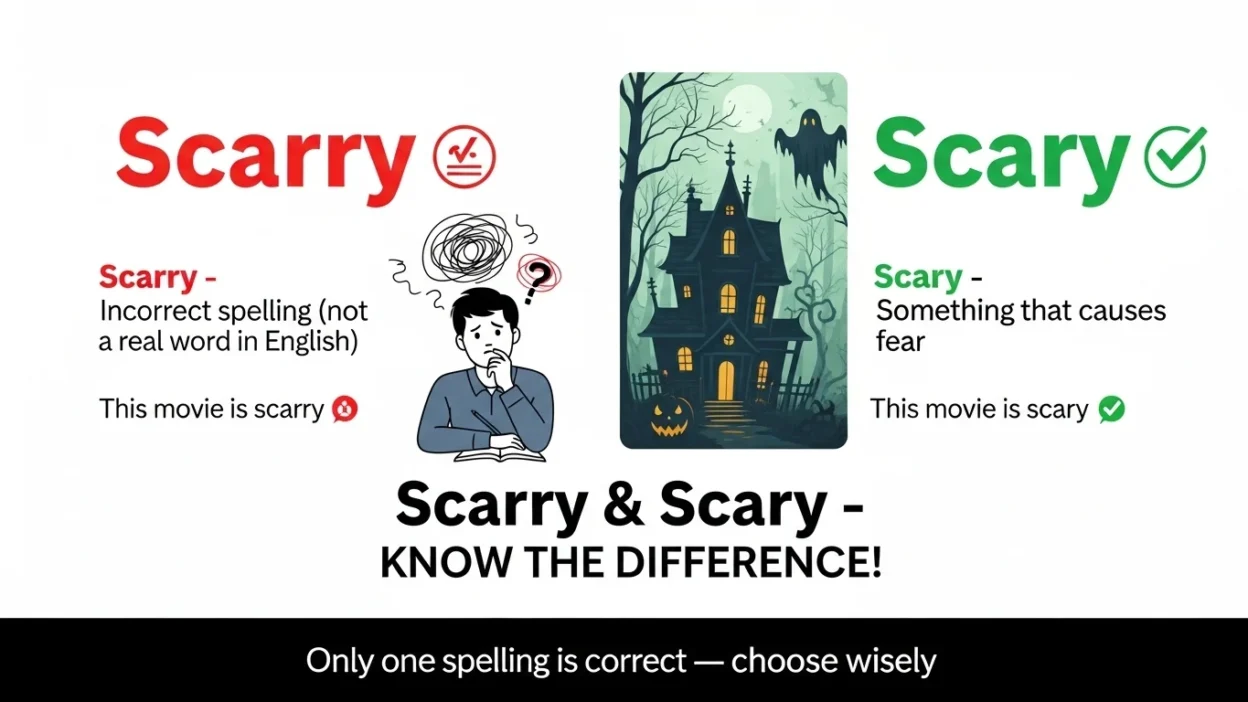
Scary is the correct spelling.
Scarry is a spelling mistake and is not a real English word.
Use scary when something is frightening or makes you feel afraid.
Example:
- That movie was really scary.
- I heard a scary noise last night.
Meaning of Scary
The word scary is an adjective that describes something that causes fear, fright, or nervousness.
Simple Definition:
Scary = Something that makes you feel afraid.
Synonyms of Scary (LSI Keywords)
These related words help with SEO and understanding:
- Frightening
- Terrifying
- Spooky
- Creepy
- Horrifying
- Chilling
- Fearful
- Startling
- Nerve-wracking
- Eerie
Example Sentences
- The haunted house looked scary at night.
- That was a scary dream.
- Horror movies are scary but exciting.
- Walking alone in the dark can feel scary.
- The loud thunder sounded scary.
What About “Scarry”?
Scarry is not a correct English word. It is just a common spelling mistake of the word scary.
Why do people write scarry?
Because many English words double the letter r, like:
- Carry
- Marry
- Sorry
- Hurry
So people mistakenly think scar → scarry, but that’s not how the word is formed.
Correct form:
- Scar → Scary (not scarry)
Scarry vs Scary (Comparison Table)
| Word | Correct or Incorrect | Meaning | Example |
| Scary | Correct | Something that causes fear | That movie is scary |
| Scarry | Incorrect | Not a real word | Wrong spelling |
Common Mistakes People Make
Here are very common mistakes with scarry vs scary:
Mistake 1: Adding Extra “R”
❌ Scarry movie
✅ Scary movie
Mistake 2: Confusing With “Scar”
- Scar = a mark on the skin
- Scary = something frightening
Example:
- He has a scar on his face.
- That mask looks scary.
Mistake 3: Wrong Spelling in Writing
Many students write:
- Scarry story ❌
- Scary story ✅
Easy Trick to Remember the Correct Spelling
Use this simple memory trick:
Scar + Y = Scary
There is only one R in scar, so there is only one R in scary.
This trick helps many learners remember the correct spelling quickly.
American vs British English
Good news! There is no difference between American and British English for this word.
| American English | British English |
| Scary | Scary |
Both use scary as the correct spelling.
Scarry is incorrect in both American and British English.
More Example Sentences (Daily Use)
Here are more real-life examples to help you understand:
- That was a scary experience.
- The forest looks scary at night.
- I watched a scary horror film yesterday.
- The dog sounded scary, but it was friendly.
- It’s scary to walk alone in an empty street.
- The clown in the movie was very scary.
- I told him a scary story.
When to Use Scary
Use scary when talking about:
- Horror movies
- Ghost stories
- Night experiences
- Dangerous situations
- Strange noises
- Nightmares
- Haunted places
Examples:
- Scary movie
- Scary story
- Scary sound
- Scary place
- Scary dream
- Scary moment
FAQs
1. Is scarry a correct word?
No, scarry is not a correct English word. The correct spelling is scary.
2. Why do people write scarry instead of scary?
People think the word needs double r like carry or sorry, but scary only has one r.
3. What does scary mean?
Scary means something that makes you feel afraid or frightened.
4. How do you spell scary correctly?
Correct spelling: S-C-A-R-Y
5. Is scary an adjective?
Yes, scary is an adjective because it describes something.
6. What is the noun of scary?
The noun form is scariness.
Example:
- The scariness of the movie made me scream.
7. What is the verb form of scary?
The verb is scare.
Example:
- The noise scared me.
8. Can scary be used for people?
Yes.
Example:
- The man looked scary.
- The teacher was scary when angry.
Summary
Understanding the difference between scarry vs scary is actually very simple once you remember the basic rule. Scary is the correct spelling and means something that makes you feel afraid, while scarry is just a spelling mistake and should not be used in English writing.
Many people make this mistake because they think the word follows the same pattern as words like carry or marry, but scary comes from the word scar, so it only has one r.
To avoid this mistake, just remember the formula: Scar + Y = Scary. This small trick can help you spell the word correctly every time.
If you are writing an essay, a blog post, or a message, using the correct spelling scary will make your English look more professional and accurate.
Actionable Takeaway
Here’s what you should remember:
- Scary = Correct spelling
- Scarry = Wrong spelling
- Use scary for anything frightening.
- Remember: Scar + Y = Scary (one R only)
If you remember this one rule, you will never make the scarry vs scary mistake again.

Ethan William is the author behind SpellPeak, passionate about clear communication and meaningful language. He writes to help readers express ideas with confidence, simplicity, and impact. His work focuses on clarity, learning, and empowering individuals and businesses through thoughtful, practical content. He values creativity, consistency, and ethical digital publishing worldwide.