
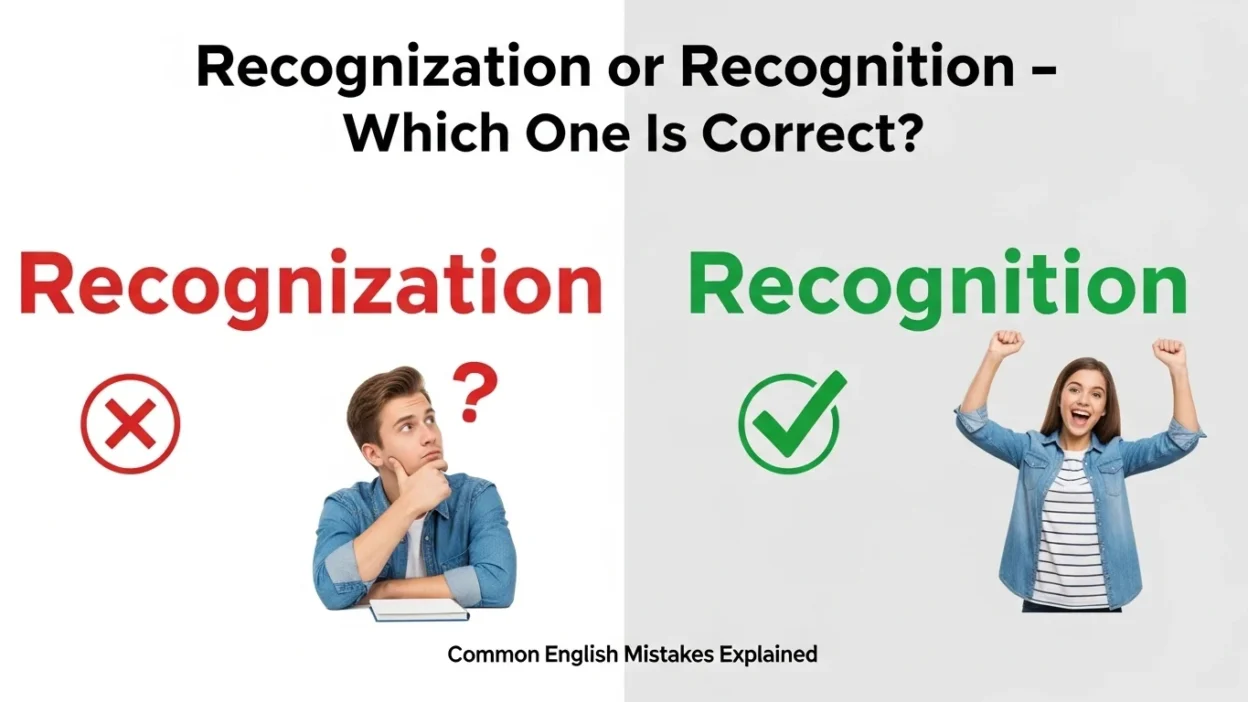
Have you ever typed “recognization” and wondered if it’s actually correct? You’re not alone. Many English learners and even native speakers get confused between recognization vs recognition because both seem logical and similar. However, only one of these words is considered correct in standard English.
In this guide, we’ll clearly explain the difference between recognization vs recognition, why one is correct and the other isn’t, and how you can avoid this common spelling mistake. By the end, you’ll understand the correct usage, see real examples, and learn simple tips to remember the right spelling every time.
Quick Answer
- Recognition is the correct and standard English word.
- Recognization is not considered correct in modern standard English and should generally be avoided.
Example:
✔ She received recognition for her hard work.
❌ She received recognization for her hard work.
In professional writing, academic work, and everyday communication, recognition is the only recommended spelling.
Meaning of Recognition
Recognition is a noun that refers to identifying someone or something, or acknowledging achievements, status, or existence.
Common Meanings
- Identifying someone or something
- Acknowledging achievements or contributions
- Official approval or acceptance
- Realizing or understanding something
Examples
- The teacher gave her recognition for excellent performance.
- Facial recognition technology is widely used in smartphones.
- His talent finally received the recognition it deserved.
- The country gained international recognition after the agreement.
Related Words
These related terms help reinforce the meaning:
- recognize
- recognized
- recognizing
- recognition award
- recognition system
- recognition ceremony
What Does Recognization Mean?
Recognization is sometimes used mistakenly as a noun form of “recognize,” but it is not accepted as standard English in most dictionaries or style guides.
While the word might appear logical because English often forms nouns with “-ization,” the correct historical form that developed and became standard is recognition.
Why People Use Recognization
There are a few reasons this mistake happens:
- The verb recognize ends with -ize, so people expect -ization.
- Other words follow this pattern (organize → organization).
- Non-native speakers may apply similar grammar rules.
However, English vocabulary evolved differently for this word.
❌ Incorrect: The company gave him recognization.
✔ Correct: The company gave him recognition.
Recognization vs Recognition: Key Differences
| Feature | Recognition | Recognization |
| Correct English | Yes | No |
| Dictionary acceptance | Yes | Rare/Incorrect |
| Common usage | Very common | Very rare |
| Professional writing | Recommended | Avoid |
| Meaning | Acknowledgment or identification | Intended same meaning but incorrect |
Conclusion: Always use recognition.
Why Recognition Is the Correct Word
The word recognition comes from the Latin root recognitio, which means “to acknowledge or know again.”
English adopted the noun recognition, and it became the standard form used in literature, academic writing, and everyday speech.
Even though many English words follow the -ization pattern, this particular word evolved differently.
Examples of correct forms:
- organize → organization
- realize → realization
- authorize → authorization
But:
- recognize → recognition
English often contains exceptions like this, which makes spelling tricky.
Common Mistakes With Recognition
Many writers accidentally create incorrect forms when trying to convert verbs into nouns.
Mistake 1: Adding “-ization”
❌ recognization
✔ recognition
Mistake 2: Confusing pronunciation
Because both words sound similar, people assume they are interchangeable.
Example:
❌ Employee recognization program
✔ Employee recognition program
Mistake 3: Overgeneralizing grammar rules
English learners sometimes apply one grammar rule to all words.
However, English vocabulary contains many irregular forms.
Quick Tip to Remember
Think of the phrase:
“Recognition brings respect.”
Both start with R, making it easier to remember the correct spelling.
Examples in Everyday Sentences
Here are practical examples using recognition correctly.
Workplace
- The company held a recognition ceremony for top employees.
- She received recognition for her leadership skills.
Technology
- Smartphones now use facial recognition for security.
- Voice recognition software helps people with disabilities.
Education
- Students received recognition awards for academic excellence.
- His research gained international recognition.
Social Context
- Artists often struggle before gaining public recognition.
- The charity deserves more recognition for its work.
American vs British English Differences
In the case of recognization vs recognition, there is no difference between American and British English.
Both varieties use:
✔ Recognition
And both consider recognization incorrect or extremely uncommon.
This makes it easier to remember because the spelling is consistent worldwide.
Related Words in Both Dialects
American English and British English both use:
- recognize
- recognized
- recognizing
- recognition
So you don’t need to worry about regional spelling differences here.
Synonyms of Recognition
Using synonyms can help improve writing variety.
Some useful alternatives include:
- acknowledgment
- appreciation
- identification
- approval
- acceptance
- validation
- credit
Example:
Her work finally received acknowledgment from the organization.
Tips to Avoid This Spelling Mistake
Here are simple strategies to avoid writing recognization.
1. Memorize the correct noun
Verb: recognize
Noun: recognition
2. Use spell check tools
Most grammar tools automatically flag recognization as incorrect.
3. Read more English content
Seeing the correct word repeatedly helps reinforce memory.
4. Practice writing examples
Create sentences using recognition to build habit.
Example practice:
- Recognition is important for motivation.
- Public recognition boosts confidence.
FAQs
1. Is recognization a real word?
Technically, it has appeared rarely in historical texts, but it is not accepted in modern standard English. Use recognition instead.
2. Why do people say recognization?
People assume the noun form of recognize should follow the -ization pattern, similar to words like organization.
3. Is recognition correct in American English?
Yes. Recognition is the correct spelling in both American and British English.
4. Can recognization ever be used?
In modern writing, it is strongly discouraged. Editors and grammar guides recommend avoiding it.
5. What is the verb form of recognition?
The verb form is recognize.
Example:
I recognize her from school.
6. What is a recognition award?
A recognition award is given to acknowledge someone’s achievements or contributions.
7. Is recognition used in technology?
Yes. Terms like facial recognition, speech recognition, and pattern recognition are widely used.
8. How can I remember the correct spelling?
Think of the phrase:
“Recognition shows appreciation.”
Remembering the correct noun form helps avoid mistakes.
Summary
The confusion between recognization vs recognition is common, but the rule is simple. Recognition is the correct and widely accepted word in English, while recognization is considered incorrect in modern usage.
If you are writing an email, academic paper, or professional document, always choose recognition.
Understanding this difference can improve your writing clarity and professionalism. English contains many tricky spelling patterns, but learning these small distinctions helps you communicate more confidently and accurately.
Actionable Takeaway
Whenever you need the noun form of recognize, remember this rule:
Recognize → Recognition (not recognization)
Practice using the correct word in sentences, and soon it will become a natural part of your vocabulary.
Meta Description:

Noah Jacob is the administrator of SpellPeak, responsible for managing website operations, content coordination, and platform performance. He ensures smooth functionality, security, and reliability while supporting the team in delivering a seamless, user-focused experience and maintaining high standards of quality across the site.