
Have you ever paused mid-sentence, wondering whether to write puting or putting? You’re not alone. This tiny spelling difference trips up students, writers, and even professionals every day.
And because it’s such a common verb, using the wrong form can quietly weaken your writing.
If you’re searching for clarity on puting vs putting, this guide gives you a simple, confident answer plus examples, grammar rules, common mistakes, and expert-backed explanations.
Let’s clear up the confusion once and for all.
Quick Answer:
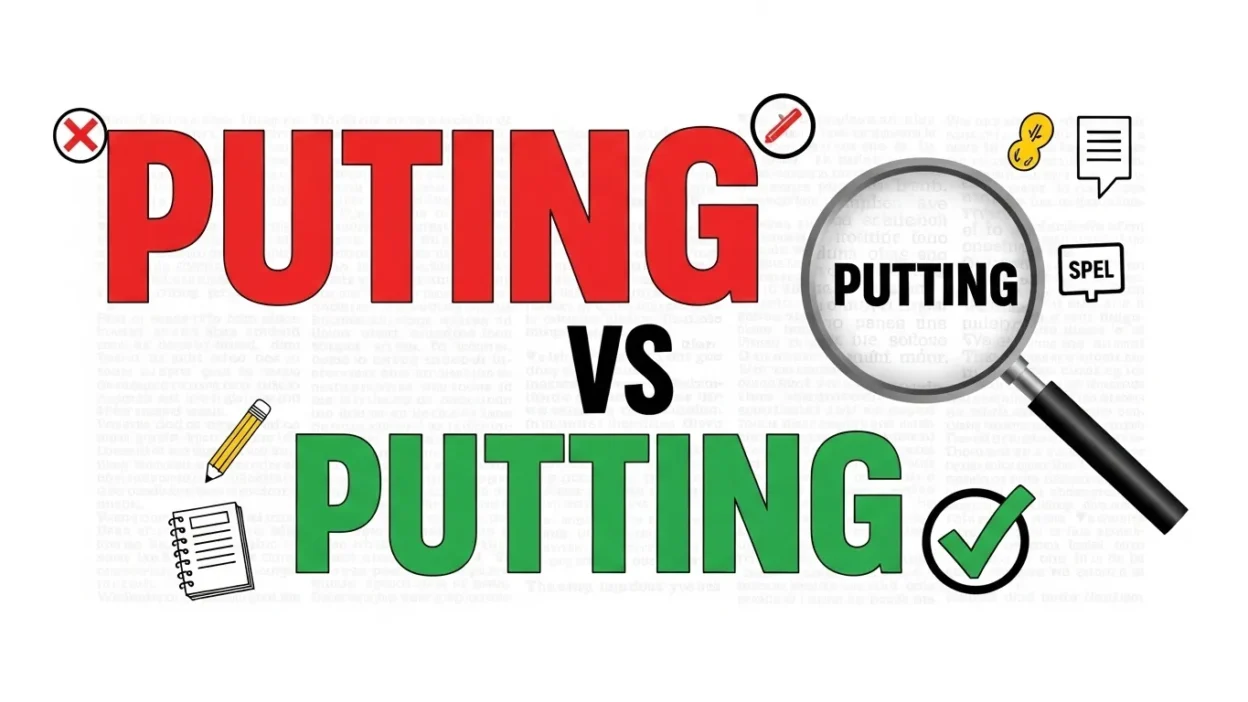
The correct spelling is putting (with double “t”).
“Puting” is incorrect in standard English and is considered a spelling mistake.
Why? Because when forming the present participle (–ing form) of short verbs like “put,” you double the final consonant before adding “-ing.”
Correct: putting
Incorrect: puting
Understanding the Meaning of “Putting”
The word putting is the present participle and gerund form of the verb “put.”
“Put” means:
- To place something somewhere
- To set or position something
- To cause something to be in a certain state
Examples:
- She is putting the books on the shelf.
- He keeps putting off his homework.
- They are putting pressure on the company.
In all cases, the correct spelling includes two t’s.
Grammar Rule Behind “Putting”
The rule is called consonant doubling before adding -ing.
Here’s how it works:
When a verb:
- Has one syllable
- Ends in a consonant
- Has a single vowel before that consonant
You double the final consonant before adding “-ing.”
Examples:
- run → running
- sit → sitting
- stop → stopping
- put → putting
That’s why “puting” is grammatically incorrect.
Why “Puting” Is Wrong
“Puting” drops one “t,” but English spelling rules require doubling the final consonant in this case.
Because:
- “Put” is a one-syllable word.
- It ends in a single consonant (t).
- It has one vowel (u) before that consonant.
So it must become putting, not puting.
In formal writing, academic essays, emails, business documents, and blog posts, “puting” is considered a clear spelling error.
Common Contexts Where “Putting” Is Used
You’ll often see “putting” in these phrases:
- Putting effort into something
- Putting someone first
- Putting things in perspective
- Putting pressure on
- Putting up with someone
- Putting down roots
- Putting aside money
Example sentences:
- She is putting effort into her career.
- We’re putting aside savings for the future.
- He’s putting pressure on the team to improve.
Each time, the spelling remains the same: putting.
Puting vs Putting: Side-by-Side Comparison
| Feature | Puting | Putting |
| Correct spelling | ❌ No | ✅ Yes |
| Grammatically accurate | ❌ No | ✅ Yes |
| Recognized in dictionaries | ❌ No | ✅ Yes |
| Used in formal writing | ❌ Never | ✅ Always |
| Follows consonant doubling rule | ❌ No | ✅ Yes |
There is no situation in standard English where “puting” is correct.
American vs British English Differences
Good news: there is no difference between American and British English in this case.
Both:
- 🇺🇸 American English
- 🇬🇧 British English
Spell it putting.
Unlike words such as “color/colour” or “organize/organise,” this word does not change across dialects.
Common Mistakes People Make
Let’s look at why people often write “puting” by mistake.
1. Forgetting the Consonant Doubling Rule
Many learners forget that short verbs double the final consonant before adding “-ing.”
2. Typing Too Fast
Autocorrect sometimes fails to catch it, especially in casual writing.
3. Confusion with Longer Verbs
Not all verbs double the final letter.
For example:
- open → opening (no doubling)
- clean → cleaning (no doubling)
But short one-syllable verbs like “put” do double the final consonant.
4. Pronunciation Confusion
Because both “puting” and “putting” may sound similar in fast speech, spelling errors can slip through unnoticed.
Examples of “Putting” in Sentences
Here are clear examples to build confidence:
Daily life:
- I’m putting my phone away now.
- She’s putting the groceries in the fridge.
Workplace:
- The manager is putting new policies in place.
- They’re putting more focus on customer service.
Academic writing:
- Researchers are putting forward a new theory.
- The study emphasizes putting students first.
Each example follows correct spelling rules.
Related Grammar Patterns (LSI Keywords)
If you’re researching puting vs putting, you might also be interested in:
- Spelling rules for adding -ing
- Double consonant rule
- Present participle examples
- Common English spelling mistakes
- Verb forms in English grammar
- English grammar tips
- Gerund vs participle
Understanding this one rule helps you avoid similar errors in other verbs.
How to Remember the Correct Spelling
Here’s an easy trick:
If the base verb is short and strong like put, give it “extra support” by doubling the final letter before adding “-ing.”
Think of it this way:
Put needs a twin T when it’s doing something.
Put → Putting
Once you internalize that pattern, you’ll rarely make this mistake again.
FAQs
1. Is “puting” ever correct?
No. “Puting” is always incorrect in standard English.
2. Why does “put” become “putting”?
Because English grammar requires doubling the final consonant when adding “-ing” to short, one-syllable verbs ending in a consonant.
3. Is “putting” a gerund or participle?
It can be both.
- As a gerund: “Putting effort matters.”
- As a participle: “She is putting the book down.”
4. Do American and British English spell it differently?
No. Both American and British English spell it putting.
5. Why doesn’t “open” become “oppening”?
Because “open” has two syllables and doesn’t follow the short-vowel single-consonant rule that requires doubling.
6. Is “putting” only used for placing objects?
No. It’s also used in idiomatic expressions like:
- putting off
- putting up with
- putting down
- putting across
7. Does spell-check always catch “puting”?
Not always. That’s why understanding the grammar rules is important.
Final Summary:
When comparing puting vs putting, the answer is clear and consistent: putting is the only correct spelling. The double “t” follows a fundamental English grammar rule: short verbs ending in a single consonant require consonant doubling before adding “-ing.” “Puting” is simply a spelling error.
If you’re writing an academic paper, a professional email, or a casual message, using “putting” correctly strengthens your credibility and clarity. Even small spelling mistakes can affect how polished your writing appears.
Actionable Takeaway
Whenever you add “-ing” to a short, one-syllable verb like “put,” pause and check:
Does it end in a single consonant?
If yes → Double it.
Put → Putting
Run → Running
Sit → Sitting
Master this one rule, and you’ll eliminate a whole category of common spelling mistakes from your writing.

Matthew Benjamin is a contributing author at SpellPeak, dedicated to clear, engaging, and purposeful writing. He focuses on creating informative content that helps readers understand complex ideas with ease. His work emphasizes accuracy, creativity, and practical value, supporting better communication and thoughtful digital learning for a global audience.