Confused about more then vs more than? You’re not alone. This tiny difference trips up students, bloggers, professionals, and even native English speakers.
It looks harmless, but using the wrong phrase can instantly weaken your writing and credibility.
The good news? This is one of the easiest grammar mistakes to fix once you understand the rule.
In this guide, you’ll learn the clear difference, see real examples, avoid common mistakes, and walk away confident about when to use more than and why more then is almost always wrong.
Quick Answer:
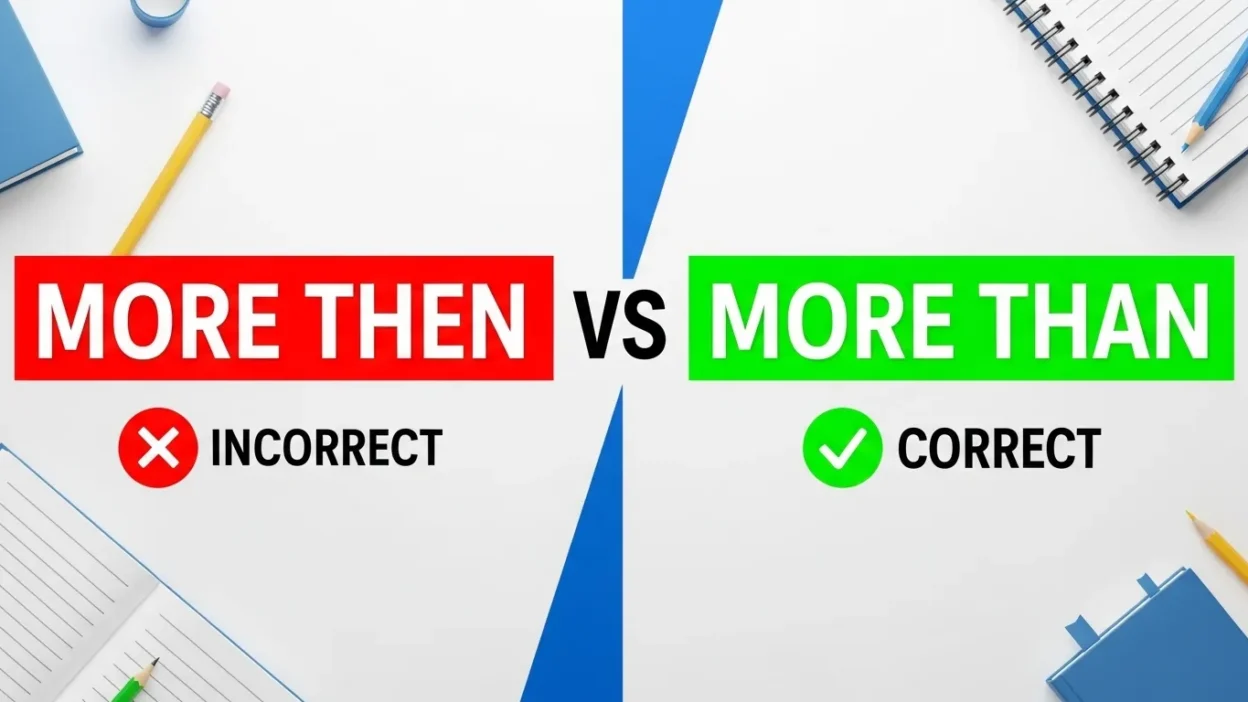
- ✅ More than is correct when comparing quantities, numbers, amounts, or degrees.
- ❌ More then is almost always incorrect.
- “Then” relates to time or sequence, not comparison.
If you’re comparing something, you need more than, not more then.
What Does “More Than” Mean?
More than is a comparative phrase. It’s used to show that something exceeds a number, amount, level, or degree.
It answers questions like:
- How much?
- How many?
- To what extent?
Examples of “More Than”
- She has more than 10 years of experience.
- This book sold more than 1 million copies.
- I care more than you think.
- He is more than capable of handling the task.
- The movie was more than entertaining.
In all these examples, something is being compared or measured.
Related LSI Keywords
- greater than
- exceeding
- higher than
- over
- in excess of
- additional
- beyond
These phrases often function similarly to more than in comparison contexts.
What Does “More Then” Mean?
Here’s the key: “more then” is almost always grammatically incorrect.
The word then refers to:
- Time (at that time)
- Sequence (what happens next)
- Consequence (in that case)
Examples of “Then” Used Correctly
- Finish your homework, then you can watch TV.
- Back then, life was simpler.
- If that’s true, then we should act quickly.
Notice that “then” relates to time or order not comparison.
When people write “more then,” they usually mean “more than.”
Why People Confuse More Then vs More Than
The confusion happens because:
- The words sound similar in fast speech.
- Both are short function words.
- Spell-check sometimes misses the mistake.
- Typing errors are common.
It’s a classic homophone-style confusion similar to:
- your vs you’re
- there vs their
- affect vs effect
But unlike some grammar debates, this one has a clear rule.
Side-by-Side Comparison Table
| Feature | More Than | More Then |
| Correct grammar | ✅ Yes | ❌ No (almost always incorrect) |
| Used for comparison | ✅ Yes | ❌ No |
| Used for time/sequence | ❌ No | ✅ Yes (only “then”) |
| Example | More than 50 people came. | Incorrect usage |
| Meaning | Greater in number, amount, or degree | Usually a typo |
This simple comparison makes the distinction easy to remember.
Easy Trick to Remember the Difference
Think of it this way:
- Than = Comparison
- Then = Time
Both words start with different letters for a reason.
If you’re comparing two things, use than.
If you’re talking about time or what happens next, use then.
Quick Memory Tip
“Comparisons need an A thAn.”
Common Mistakes With More Then vs More Than
Let’s look at frequent grammar errors and how to fix them.
❌ Incorrect:
- She has more then enough money.
- There were more then 20 guests.
- I like coffee more then tea.
✅ Correct:
- She has more than enough money.
- There were more than 20 guests.
- I like coffee more than tea.
These are simple comparison sentences they always require than.
Is There Ever a Correct Use of “More Then”?
Technically, yes but not in the way people usually mean.
You could write something like:
- We had more, then we left.
Here, “more” and “then” are separate ideas. But that’s rare and unrelated to the common mistake.
In 99% of cases, if you see “more then,” it’s a grammar error.
American vs British English: Is There Any Difference?
Great question.
There is no difference between American and British English when it comes to more than vs more then.
Both in American English and British English:
- “More than” is correct for comparison.
- “More then” is incorrect in comparative use.
If you’re writing for a U.S., U.K., Australian, or international audience, the rule stays the same.
Using “More Than” in Different Contexts
To fully master this grammar rule, it helps to see how flexible it is.
1. Numbers and Quantity
- More than 100 students attended.
- He owns more than five businesses.
2. Time and Duration
- It took more than two hours.
- She waited more than a week.
3. Degree or Intensity
- I’m more than happy to help.
- That’s more than enough.
4. Comparison Between Two Things
- She is more intelligent than her brother.
- This option costs more than the other one.
Notice how “more than” connects two elements in comparison.
Practice Sentences (Test Yourself)
Choose the correct option:
- There were more then / more than 50 participants.
- Finish this task, then / than we’ll discuss payment.
- I expected more then / more than this.
- Back then / than, we didn’t have smartphones.
- She earns more then / more than her manager.
Answers:
- more than
- then
- more than
- then
- more than
If you got them right you’ve mastered the rule.
FAQs
1. Is “more then” ever correct?
Almost never in comparative sentences. It’s usually a typo for “more than.” “Then” refers to time or sequence, not comparison.
2. Why do people write “more then” instead of “more than”?
It’s often a typing error or confusion due to similar pronunciation. Spell-check may not always catch it because both words are valid individually.
3. Can I use “over” instead of “more than”?
Yes, in many cases. For example:
- More than 100 people
- Over 100 people
Both are grammatically correct in modern usage.
4. Is this mistake common in academic writing?
Yes. Even university students sometimes mix up “than” and “then.” However, formal writing requires correct usage.
5. Does pronunciation differ between “than” and “then”?
Yes, slightly.
- “Than” often sounds softer (thən).
- “Then” is usually pronounced clearly (then).
But in fast speech, they can sound similar.
6. Is “more than” always followed by a number?
No. It can also compare qualities or degrees:
- More than happy
- More than ready
- More than capable
7. What part of speech is “than”?
“Than” is a conjunction used for comparison.
8. What part of speech is “then”?
“Then” is usually an adverb referring to time or sequence.
Final Summary:
The difference between more then vs more than is simple but powerful. If you’re comparing numbers, quantities, degrees, or qualities, you must use more than.
The word “then” relates only to time, sequence, or consequence, never comparison. This small correction can instantly elevate your writing.
If you’re drafting emails, academic papers, blog posts, or business documents, mastering this rule improves clarity, professionalism, and reader trust.
Actionable Takeaway
Before you publish or submit anything:
- Search your document for “more then.”
- Replace it with “more than” if you’re making a comparison.
- Double-check that “then” is only used for time or sequence.
- Read your sentence aloud ask yourself: Am I comparing something?
That quick 10-second check can make your writing stronger and more polished.

Matthew Benjamin is a contributing author at SpellPeak, dedicated to clear, engaging, and purposeful writing. He focuses on creating informative content that helps readers understand complex ideas with ease. His work emphasizes accuracy, creativity, and practical value, supporting better communication and thoughtful digital learning for a global audience.