Have you ever typed miniscule and felt that little red underline staring back at you? You’re not alone. The confusion between minuscule vs miniscule is extremely common even among experienced writers.
If you’re wondering which spelling is correct, whether both are acceptable, and how to avoid making this mistake in professional writing, this guide will clear it up in simple, friendly language. Let’s settle this once and for all.
Quick Answer:
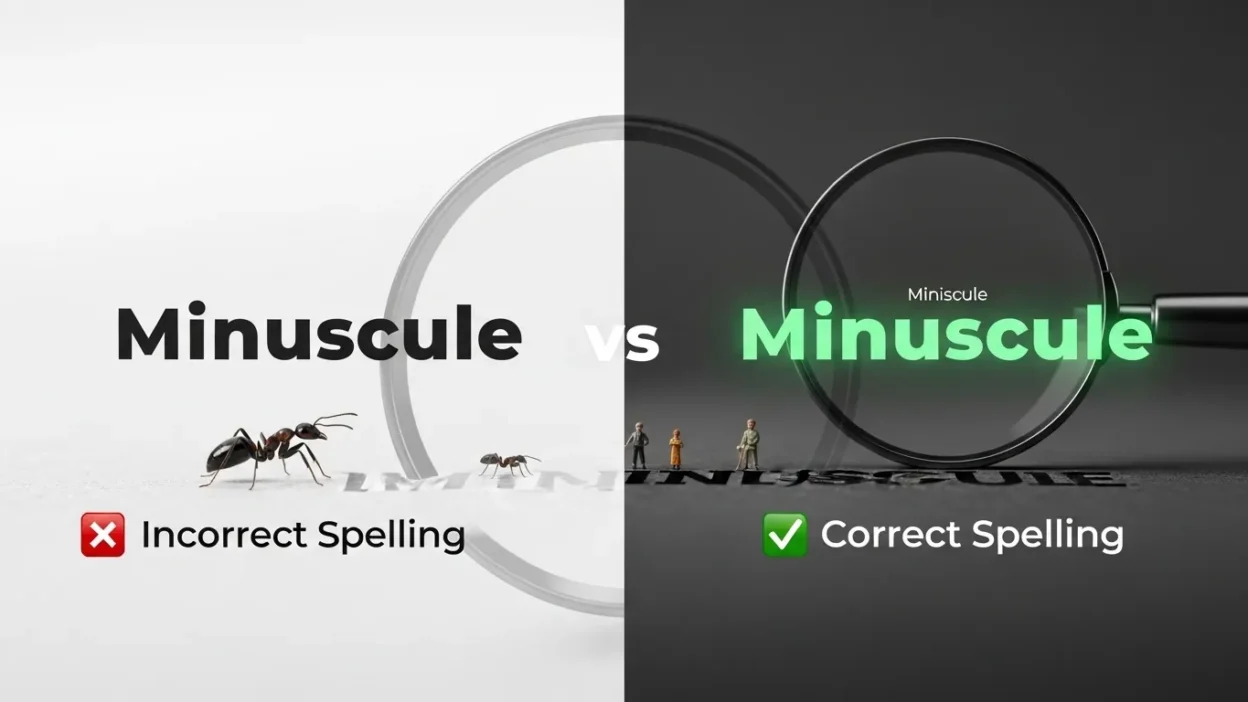
Minuscule is the correct and standard spelling.
Miniscule is considered a misspelling in formal writing.
Although miniscule appears frequently online and in informal use, dictionaries and grammar authorities recognize minuscule as the proper form.
What Does “Minuscule” Mean?
The word minuscule means:
- Extremely small
- Tiny in size, amount, or importance
- Insignificant or minute
It is often used as a synonym for:
- Tiny
- Minute
- Microscopic
- Trivial
- Insignificant
- Negligible
- Infinitesimal
Example Sentences
- The error was minuscule, but it changed the entire result.
- She noticed a minuscule crack in the glass.
- The chances of winning were minuscule.
In all of these examples, the word describes something very small either physically or figuratively.
Why Do People Spell It “Miniscule”?
The confusion between minuscule vs miniscule happens for a simple reason: pronunciation.
When spoken quickly, many people pronounce minuscule as:
mi-ni-SKYULE
Because it sounds like it contains “mini,” writers assume it should be spelled miniscule but that’s incorrect.
Interestingly, the word does not come from “mini.” Its origin is from the Latin minusculus, meaning “somewhat smaller.”
That historical spelling explains why the correct version contains -nuscule, not -niscule.
The Origin of Minuscule
The word minuscule traces back to Medieval Latin minusculus, meaning “rather small.” It also relates to handwriting.
In fact, in typography and manuscript writing, “minuscule” refers to lowercase letters, as opposed to “majuscule” (uppercase letters). You may see this term used in discussions of medieval scripts or historical writing systems.
This historical origin is why the spelling includes -nu- instead of -ni-.
Is “Miniscule” Ever Correct?
In modern standard English:
- ❌ Miniscule is considered a misspelling.
- ✅ Minuscule is correct in both American and British English.
Major dictionaries like Merriam-Webster Dictionary and Oxford English Dictionary list minuscule as the correct spelling.
Some dictionaries may note miniscule as a “variant” due to common usage, but it is still treated as nonstandard in formal writing, academic papers, journalism, and professional communication.
If you want to write with clarity and authority, always use minuscule.
Minuscule vs Miniscule: Side-by-Side Comparison
| Feature | Minuscule | Miniscule |
| Correct spelling | ✅ Yes | ❌ No (nonstandard) |
| Recognized by dictionaries | Yes | Listed as misspelling or variant |
| Used in formal writing | Yes | No |
| Origin-based spelling | Yes | No |
| Recommended for SEO and academic writing | Yes | No |
When in doubt, choose minuscule every time.
American vs British English Differences
Here’s some good news: there is no difference between American and British English in this case.
- 🇺🇸 American English: minuscule
- 🇬🇧 British English: minuscule
Both varieties follow the same spelling. Unlike words such as “color/colour” or “organize/organise,” this word does not change across regions.
Common Mistakes People Make
Understanding common grammar mistakes helps you avoid them. Here are the most frequent errors related to minuscule vs miniscule:
1. Spelling It Like “Mini”
Because “mini” means small, writers assume:
mini + scule = miniscule
But that’s incorrect. The word has nothing to do with the prefix “mini.”
2. Ignoring Spell-Check Warnings
Many writing tools flag miniscule as incorrect. Ignoring those warnings can reduce credibility in professional writing.
3. Mixing It With “Minute”
People often confuse:
- Minute (my-NOOT or MIN-it)
- Minuscule (mi-NUH-skyool)
Although both relate to smallness, they are different words.
4. Using It in Academic Writing Incorrectly
In essays, research papers, or business proposals, using miniscule instead of minuscule can weaken perceived expertise.
If you care about polished, professional communication, this is a small but important detail.
More Example Sentences for Clarity
Here are practical examples showing correct usage in different contexts:
Business Context
- The company saw only a minuscule increase in quarterly profits.
- The difference in cost was minuscule, almost negligible.
Science Context
- Scientists detected a minuscule amount of radiation.
- The organism is minuscule, visible only under a microscope.
Everyday Conversation
- It’s just a minuscule scratch.
- The risk is minuscule, so don’t worry.
Notice how the word naturally replaces “tiny,” “small,” or “insignificant.”
How to Remember the Correct Spelling
Here’s an easy memory trick:
Think of the word “minus.”
Minuscule contains the word “minus,” which also relates to something smaller.
MINUS → MINUSCULE
This can help you avoid accidentally writing “miniscule.”
Another tip:
If your spell-check underlines it, trust the correction.
When Should You Use “Minuscule”?
Use minuscule when describing:
- Extremely small objects
- Slight differences
- Insignificant amounts
- Minor risks
- Trivial details
It’s especially useful in formal writing, academic contexts, journalism, SEO content, and professional emails.
FAQs
1. Is “miniscule” a real word?
Technically, it appears in some dictionaries due to common usage, but it is considered a misspelling of minuscule and should be avoided in formal writing.
2. Why do so many people spell it “miniscule”?
Because it sounds like it contains “mini,” and people naturally associate the meaning with “mini” (small). The pronunciation causes confusion.
3. Is minuscule the same as minute?
Not exactly. Both mean small, but “minute” can also refer to time. “Minuscule” strictly emphasizes extreme smallness.
4. Do Americans and British spell it differently?
No. Both American and British English use minuscule.
5. Is it unprofessional to write “miniscule”?
Yes, especially in academic, corporate, or published content. It may reduce credibility.
6. What part of speech is minuscule?
It is primarily an adjective. In typography, it can also function as a noun referring to lowercase letters.
7. Can I use minuscule in formal essays?
Absolutely. It’s a strong, precise word appropriate for academic and professional writing.
8. How is minuscule pronounced correctly?
It is commonly pronounced:
mi-NUH-skyool
Though pronunciation variations exist, the spelling remains minuscule.
Summary:
To wrap it up clearly:
Minuscule is the correct spelling and means extremely small or insignificant.
Miniscule is a common misspelling caused by pronunciation confusion.
There is no American vs British difference, and major dictionaries including Merriam-Webster Dictionary and Oxford English Dictionary recognize only minuscule as standard.
If you want polished, professional writing, always choose minuscule.
Actionable Takeaway
Starting today:
- Double-check your spelling.
- Use spell-check tools wisely.
- Remember the “minus” trick.
- Avoid “miniscule” in formal contexts.
It’s a tiny adjustment but it makes a powerful difference in your writing clarity and credibility.

Ethan William is the author behind SpellPeak, passionate about clear communication and meaningful language. He writes to help readers express ideas with confidence, simplicity, and impact. His work focuses on clarity, learning, and empowering individuals and businesses through thoughtful, practical content. He values creativity, consistency, and ethical digital publishing worldwide.