If you’ve ever paused mid-sentence wondering whether to write “layed out” or “laid out,” you’re not alone. This is one of the most common grammar mix-ups in English, especially because the words sound similar and come from the same root verb.
The good news? Once you understand one simple rule, you’ll never get confused again. In this guide, we’ll break down the difference in a clear, friendly way with examples, mistakes to avoid, and practical tips you can use right away.
Quick Answer
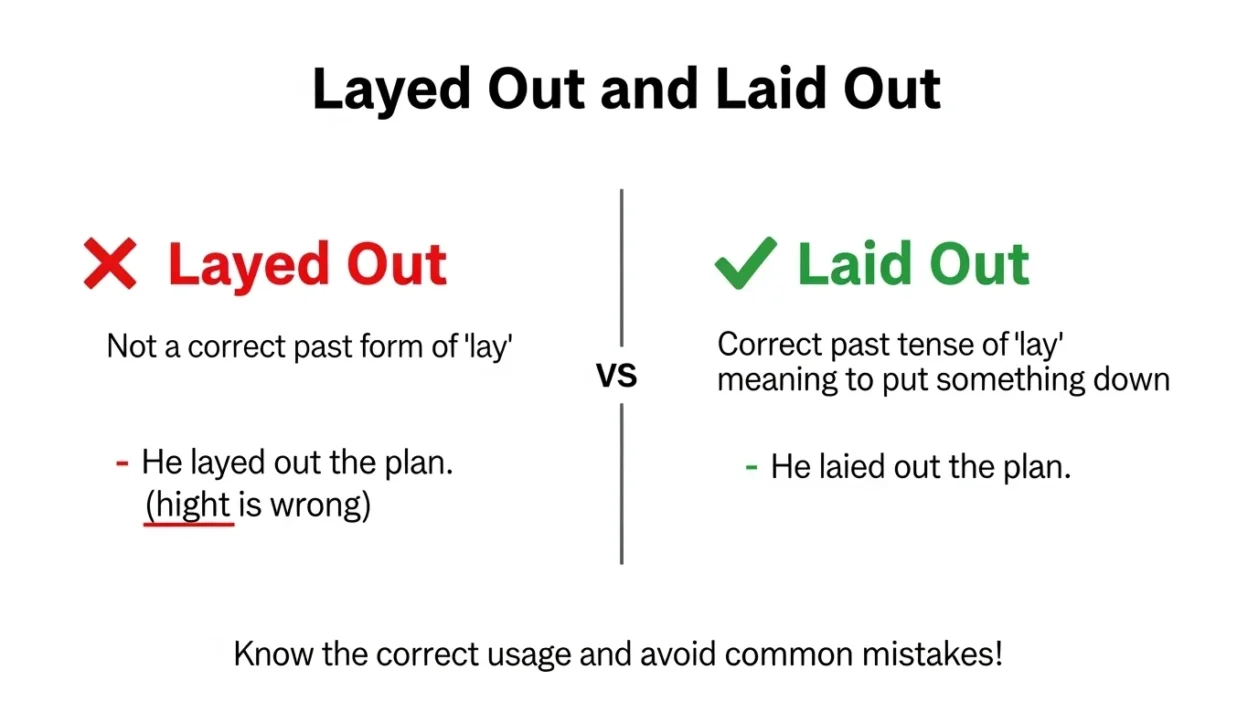
- ✅ “Laid out” is correct
- ❌ “Layed out” is incorrect (not a proper word)
Use “laid out” as the past tense of lay.
Example: She laid out the clothes for tomorrow.
What Does “Laid Out” Mean?
“Laid out” is the correct past tense and past participle of the verb “lay,” which means:
- To put something down carefully
- To arrange or organize something
- To explain something clearly
Examples:
- He laid out the plan step by step.
- She laid out all the ingredients on the table.
- The teacher laid out the rules clearly.
In all these sentences, “laid out” shows an action that already happened.
Why “Layed Out” Is Incorrect
Here’s the simple truth:
👉 “Layed” is not a real word in standard English.
Many people assume “layed” follows the pattern of regular verbs (like played or stayed), but “lay” is an irregular verb, so its past tense is “laid,” not “layed.”
Incorrect Examples:
- ❌ He layed out the documents.
- ❌ She layed out her clothes.
Correct Versions:
- ✅ He laid out the documents.
- ✅ She laid out her clothes.
Understanding the Verb “Lay”
To fully understand “laid out,” it helps to look at the base verb:
| Tense | Verb Form |
| Present | lay |
| Past | laid |
| Past Participle | laid |
Important Tip:
“Lay” always needs an object (something you’re placing or arranging).
✔ She lays the book on the table.
✔ She laid the book on the table.
Common Confusion: “Lay” vs “Lie”
Another reason people get confused is the similarity between “lay” and “lie.”
Here’s a quick breakdown:
| Verb | Meaning | Past Tense | Example |
| Lay | Put something down | Laid | She laid the keys down |
| Lie | Recline/rest | Lay | He lay on the bed |
Example Comparison:
- She laid out the blanket. (correct)
- He lay on the blanket. (different verb)
Notice how “lay” (past of lie) adds to the confusion!
Real-Life Examples of “Laid Out”
Here are practical, everyday examples to help you remember:
1. Organizing Items
- She laid out her outfit for the interview.
- They laid out the tools before starting work.
2. Explaining Ideas
- The manager laid out the project timeline.
- He laid out his argument clearly.
3. Planning or Arranging
- The event planner laid out the seating arrangement.
- We laid out our travel itinerary.
Common Mistakes to Avoid
Even advanced English users make these mistakes. Watch out for:
1. Adding “-ed” Automatically
- ❌ layed out
- ✅ laid out
2. Mixing Up Lay and Lie
- ❌ He laid on the couch all day.
- ✅ He lay on the couch all day.
3. Overthinking It
If you mean placing or arranging something, just remember:
👉 Use “laid out.”
American vs British English
Here’s some good news:
There is no difference between American and British English for this phrase.
- 🇺🇸 American English: laid out
- 🇬🇧 British English: laid out
Both forms follow the same rule, and “layed out” is incorrect in both versions.
LSI Keywords and Related Phrases
To deepen your understanding, here are related terms often used with “laid out”:
- arranged
- organized
- spread out
- set up
- explained clearly
- presented
- structured
These can often be used as synonyms depending on context.
Comparison Table: Layed Out vs Laid Out
| Feature | Layed Out | Laid Out |
| Correct spelling | ❌ No | ✅ Yes |
| Standard English | ❌ Not accepted | ✅ Accepted |
| Usage in writing | ❌ Avoid | ✅ Use confidently |
| Verb form | ❌ Incorrect | ✅ Past tense of “lay” |
FAQs
1. Is “layed out” ever correct?
No. “Layed” is not a standard English word, so it’s always incorrect.
2. Why do people use “layed out”?
Because many English verbs form the past tense by adding -ed, people assume “lay” follows the same pattern but it doesn’t.
3. What is the correct past tense of “lay”?
The correct past tense is “laid.”
4. Can “laid out” mean explained?
Yes!
Example: She laid out the instructions clearly.
5. What’s the difference between “laid out” and “set up”?
- Laid out → arranging or explaining
- Set up → preparing or establishing something
6. Is “laid out” formal or informal?
It works in both contexts:
- Formal: The report was laid out clearly.
- Informal: I laid out my clothes for tomorrow.
7. How can I remember the correct form?
Think of this simple rule:
👉 Lay → Laid → Laid (never “layed”)
8. Is “laid out” used in professional writing?
Yes, it’s commonly used in business, academic, and everyday writing.
Summary
The difference between “layed out vs laid out” is actually very simple once you know the rule. “Laid out” is the correct form because it’s the past tense of the irregular verb lay, while “layed out” is not a valid word in standard English.
If you’re writing an email, an essay, or a social media post, using “laid out” will always keep your grammar accurate and polished.
To avoid mistakes, remember that “lay” becomes “laid,” not “layed.” Practice using it in real sentences like “She laid out the plan clearly” and it will soon feel natural.
With this small but important correction, your writing will instantly sound more professional and confident.
Actionable Takeaway
- Always use “laid out” when describing something placed, arranged, or explained
- Avoid “layed out” completely it’s incorrect
- Remember: Lay → Laid → Laid

Noah Jacob is the administrator of SpellPeak, responsible for managing website operations, content coordination, and platform performance. He ensures smooth functionality, security, and reliability while supporting the team in delivering a seamless, user-focused experience and maintaining high standards of quality across the site.