Many English learners and even native speakers sometimes get confused between insue and ensue. They look similar and sound alike, but there is an important difference: one is correct English, and the other is simply a misspelling. If you’ve ever wondered which one to use in your writing, you’re not alone.
In this guide, we’ll clearly explain insue vs ensue, their meanings, examples, and common mistakes. By the end of this article, you’ll know exactly which word is correct and how to use it confidently in everyday writing.
Quick Answer
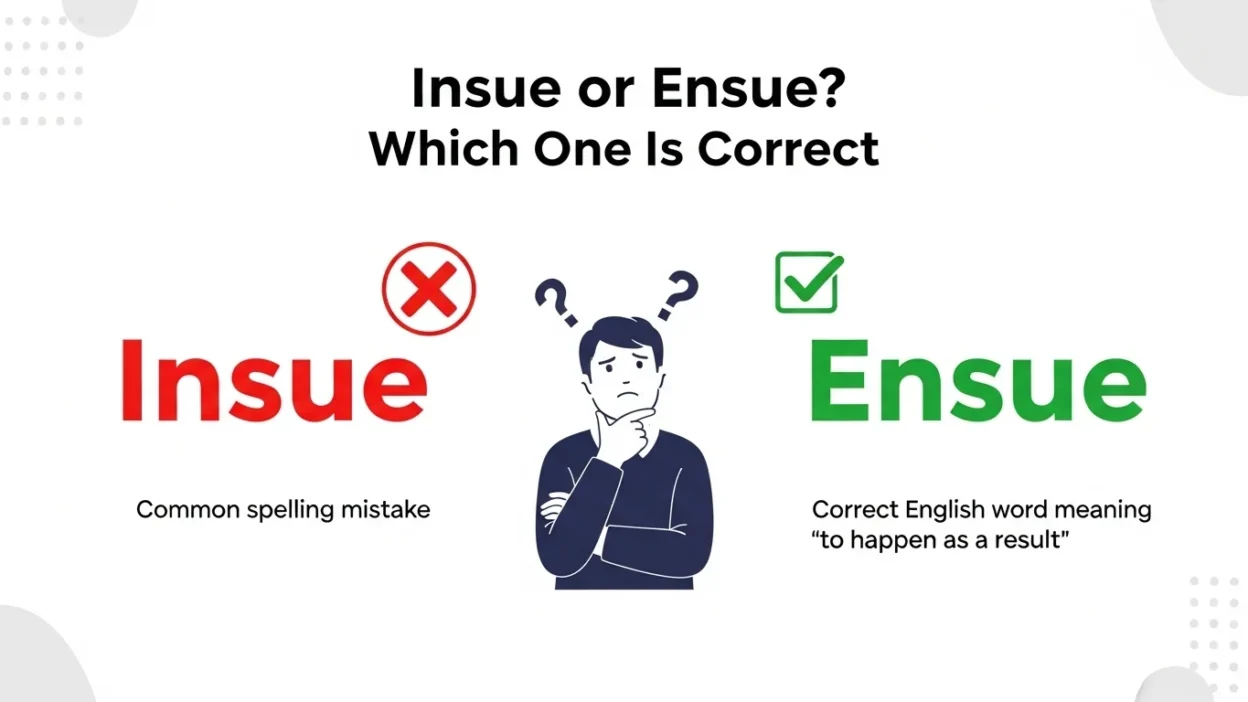
Ensue is the correct English word. It means to happen afterward or as a result of something.
Insue is not a standard English word and is simply a common misspelling of “ensue.”
Example:
- Correct: Chaos will ensue if the rules are ignored.
- Incorrect: Chaos will insue if the rules are ignored.
What Does “Ensue” Mean?
The word ensue means to happen afterward as a consequence or result of something. It is commonly used when describing events that follow another event.
In simple terms, ensue = happen next because of something else.
Examples:
- After the announcement, loud applause ensued.
- If the system crashes, serious problems may ensue.
- A heated argument ensued between the two players.
You’ll often see this word in news articles, formal writing, storytelling, and academic contexts.
Common Synonyms of Ensue
Using synonyms can improve writing variety and SEO relevance. Some related words include:
- Follow
- Result
- Occur afterward
- Develop
- Come after
- Arise
Example:
- A long discussion ensued.
- A long discussion followed.
What Is “Insue”?
The term insue is not recognized as a standard English word in dictionaries. It appears mainly due to spelling mistakes or phonetic confusion.
People sometimes write insue because the pronunciation of ensue can sound like in-soo or en-soo. However, the correct spelling always begins with “en.”
Example of incorrect usage:
- Incorrect: A misunderstanding may insue.
Correct version:
- Correct: A misunderstanding may ensue.
Insue vs Ensue: Key Differences
| Feature | Insue | Ensue |
| Correct spelling | ❌ No | ✅ Yes |
| Dictionary word | ❌ No | ✅ Yes |
| Meaning | None | To happen afterward |
| Usage in writing | Considered a typo | Standard English |
| Common context | Spelling mistake | Formal or narrative writing |
The main takeaway: Use “ensue” and avoid “insue.”
Examples of “Ensue” in Sentences
Here are several practical examples to help you understand how ensue works in real-life sentences.
Everyday Examples
- A loud cheer ensued after the team scored.
- Confusion may ensue if the instructions are unclear.
- Panic ensued when the alarm suddenly rang.
Professional Writing Examples
- Legal action may ensue if the contract is violated.
- A lengthy debate ensued during the meeting.
- Further investigation ensued following the incident.
Storytelling Examples
- The hero confronted the villain, and a fierce battle ensued.
- Silence ensued after the shocking news.
Common Mistakes When Using Ensue
Many writers accidentally misuse or misspell ensue. Here are some common mistakes to avoid.
1. Writing “Insue” Instead of “Ensue”
This is the most frequent mistake.
Incorrect:
- Trouble will insue if we ignore the warning.
Correct:
- Trouble will ensue if we ignore the warning.
2. Using Ensue Without a Cause
The word ensue usually follows an event that triggers another event.
Less clear:
- A meeting ensued.
Better:
- After the disagreement, a meeting ensued.
3. Overusing the Word
Although ensue is useful, using it too often may sound repetitive.
Example:
- A discussion followed the presentation.
When Should You Use “Ensue”?
Use ensue when describing events that happen as a result of something else.
Typical contexts include:
- News reports
- Storytelling
- Formal writing
- Academic essays
- Legal documents
Example patterns:
- After + event + ensued
- If + condition + chaos ensues
- A debate ensued
Examples:
- After the announcement, confusion ensued.
- If the rules are broken, penalties may ensue.
American vs British English
Good news: both American and British English use the word “ensue” in exactly the same way.
There are no spelling or usage differences between the two forms.
| Language Variant | Spelling | Usage |
| American English | Ensue | Standard |
| British English | Ensue | Standard |
However, the misspelling “insue” appears in both regions, mainly due to typing errors or unfamiliarity with the correct form.
Tips to Remember the Correct Spelling
If you struggle with ensue vs insue, these simple tricks can help.
Memory Trick
Think of “EN” in “ENsue” as meaning “then.”
Event → Then something happens → Ensue
Example:
- The announcement was made → applause ensued.
Another Trick
Remember that ensue starts with “EN,” just like “enter” or “end.”
It signals something that comes after.
FAQs
1. Is “insue” a real word?
No. Insue is not a recognized English word. It is simply a misspelling of ensue.
2. What does “ensue” mean?
Ensue means to happen afterward or as a result of something.
Example:
After the announcement, applause ensued.
3. How do you use “ensue” in a sentence?
You can use it when one event follows another.
Example:
- After the referee’s decision, a heated argument ensued.
4. Is “ensue” formal or informal?
Ensue is slightly formal, which is why it appears often in news writing, literature, and academic texts.
5. Can I replace “ensue” with “follow”?
Yes, in many cases.
Example:
- A discussion ensued.
- A discussion followed.
Both sentences work, though the following is more casual.
6. Why do people spell “ensue” as “insue”?
This usually happens because the pronunciation sounds similar to “in-soo.” Writers sometimes spell it the way it sounds.
7. Is “ensue” commonly used today?
Yes, especially in journalism, storytelling, and formal writing.
Example:
- Chaos ensued after the unexpected announcement.
8. What is the past tense of “ensue”?
The past tense ensued.
Example:
- A long silence ensued after the shocking news.
Summary
Understanding insue vs ensue is actually quite simple once you know the key rule. Ensue is the correct word, meaning something that happens afterward as a consequence of another event. Meanwhile, insue is simply a spelling mistake and should be avoided in all forms of writing.
Using ensue correctly can improve the clarity and professionalism of your writing, especially in formal contexts like articles, essays, or storytelling. Remember that it usually describes events that follow naturally from a previous situation.
Actionable Takeaway
Whenever you’re unsure about insue vs ensue, remember this simple rule:
✔ Ensue = correct word meaning “to happen next.”
❌ Insue = incorrect spelling.
Next time you write a sentence about something happening after another event, confidently use ensue.

Noah Jacob is the administrator of SpellPeak, responsible for managing website operations, content coordination, and platform performance. He ensures smooth functionality, security, and reliability while supporting the team in delivering a seamless, user-focused experience and maintaining high standards of quality across the site.