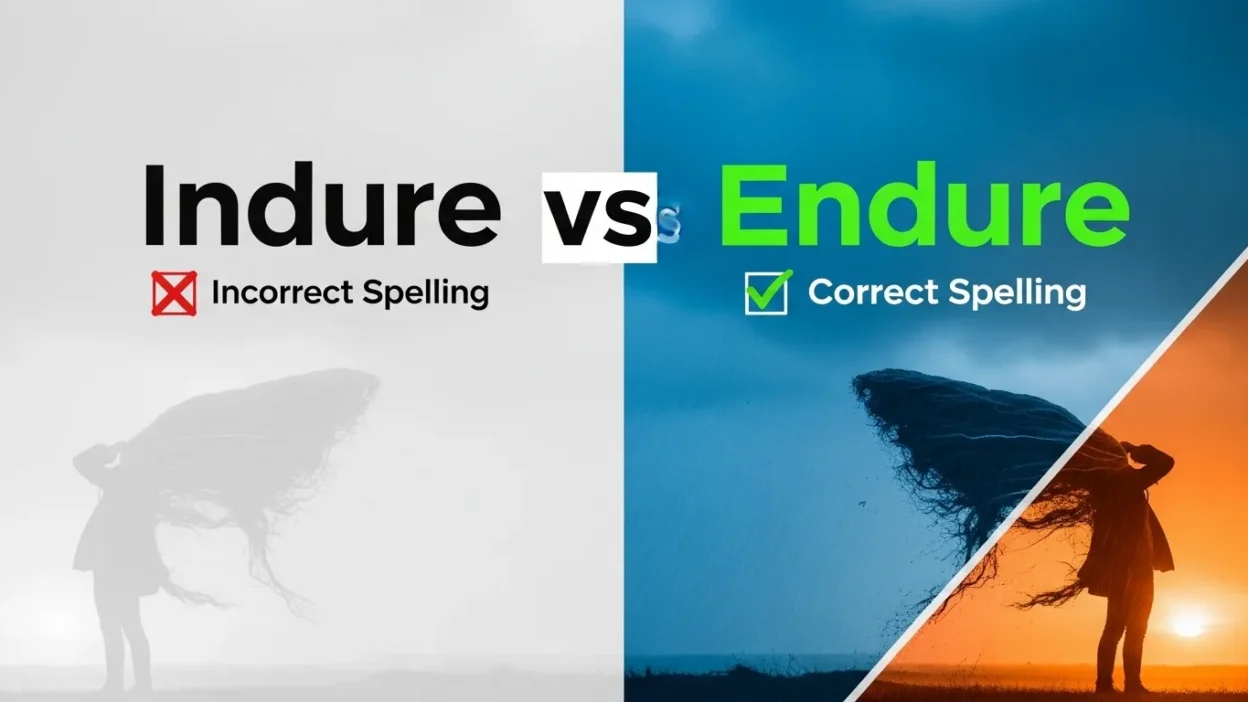
Are you confused about “indure vs endure” and wondering which one is correct? You’re not alone.
Many English learners and even native speakers sometimes mix up similar-looking words, especially when typing quickly or relying on autocorrect.
If you’ve seen “indure” in writing and paused for a second, this guide will clear up everything.
We’ll explain the correct spelling, meaning, pronunciation, examples, common mistakes, and even touch on American vs British English differences.
Let’s settle it once and for all.
Quick Answer:
The correct word is “endure.”
“Indure” is not a standard English word. It is usually a spelling mistake of “endure.”
Endure means:
- To suffer something difficult patiently
- To last over time
- To remain strong despite hardship
If you’re writing formally, academically, or professionally, always use endure.
What Does “Endure” Mean?
The verb endure means to tolerate, withstand, or survive something painful, difficult, or challenging. It can also mean to continue or last for a long time.
Definition of Endure
Endure (verb):
- To suffer something painful or difficult patiently
- To remain in existence over time
- To withstand hardship without giving up
Simple Examples
- She had to endure hours of traffic.
- They endured years of financial struggle.
- True friendship can endure through hard times.
- This monument has endured for centuries.
In each case, the word suggests strength, patience, and persistence.
Is “Indure” a Real Word?
No. Indure is not recognized in standard English dictionaries.
It is most commonly:
- A spelling mistake
- A typing error
- A phonetic confusion (because it sounds similar to “endure”)
Sometimes people mistakenly think “indure” might be a British spelling variation. It is not.
Why Do People Confuse Indure and Endure?
There are a few common reasons for this confusion:
1. Pronunciation Similarity
In fast speech, “endure” can sound like “indure.” The short “e” sound may be unclear, especially in certain accents.
2. Typing Errors
The letters “i” and “e” are close on a keyboard. It’s easy to mistype.
3. Phonetic Spelling Habits
Some learners write words based on how they hear them rather than checking correct spelling.
4. Confusion with Similar Words
Words like:
- Ensure
- Insure
- Endurance
- Injure
These similar-looking words can create mental mix-ups.
Indure vs Endure: Side-by-Side Comparison
Here’s a simple comparison table to make things crystal clear:
| Feature | Indure | Endure |
| Correct English word? | ❌ No | ✅ Yes |
| Recognized in dictionaries? | ❌ No | ✅ Yes |
| Meaning | None | To suffer, tolerate, or last |
| Formal usage | Incorrect | Correct |
| American English | Not used | Used |
| British English | Not used | Used |
There is no regional variation here. Both American and British English use endure only.
Meaning and Usage of Endure in Detail
Let’s explore how “endure” is used in different contexts.
1. Endure as “To Suffer”
This is the most common meaning.
- He had to endure criticism from his boss.
- Patients sometimes endure severe pain after surgery.
Here, endure means tolerating something unpleasant.
2. Endure as “To Last”
- Their love has endured for 40 years.
- These traditions have endured through generations.
In this sense, it means to continue over time.
3. Endure as “To Stay Strong”
- She endured hardship with courage.
- The team endured despite repeated failures.
This meaning connects with resilience and perseverance.
Related Words and LSI Keywords
To fully understand “endure,” it helps to look at related words and synonyms.
Synonyms of Endure
- Tolerate
- Withstand
- Bear
- Survive
- Persist
- Last
- Continue
- Remain
Related Words
- Endurance (noun)
- Enduring (adjective)
- Durable
- Resilience
- Perseverance
- Patience
These words often appear in similar contexts and can improve your vocabulary depth.
Common Mistakes with Endure
Let’s look at typical grammar and spelling mistakes.
Mistake 1: Writing “Indure” Instead of “Endure”
Incorrect:
- She had to indure the pain.
Correct:
- She had to endure the pain.
Mistake 2: Confusing Endure with Ensure
Endure = to suffer or last
Ensure = to make sure
Incorrect:
- Please endure that the door is locked.
Correct:
- Please ensure that the door is locked.
Mistake 3: Confusing Endure with Insure
Insure = related to insurance
Incorrect:
- He insured years of hardship.
Correct:
- He endured years of hardship.
These small spelling differences can completely change meaning.
American vs British English: Any Difference?
Good news: there is no spelling difference between American and British English for “endure.”
- American English: endure
- British English: endure
Unlike words such as “color/colour” or “organize/organise,” this word remains the same in both versions of English.
So if you’re writing for a global audience, you can confidently use endure everywhere.
How to Remember the Correct Spelling
Here are simple memory tricks:
Trick 1: Think of “End” in Endure
Hard times eventually end you endure until the end.
Both words start with “en.”
Trick 2: Connect It with Endurance
You’ve probably heard of “endurance training.”
Since endurance is correct, endure must also start with “en.”
Trick 3: Read More English Content
The more you see correct spelling in books, blogs, and articles, the more natural it feels.
Real-Life Sentences for Better Understanding
Let’s see more practical examples.
- Students sometimes endure stress during exams.
- She endured a long recovery after surgery.
- Ancient buildings have endured earthquakes and storms.
- Strong relationships endure through challenges.
- The brand’s reputation has endured for decades.
Notice how the word fits both emotional and physical situations.
When Should You Use Endure?
Use endure when you want to express:
- Surviving pain
- Tolerating discomfort
- Lasting over time
- Remaining strong despite difficulty
It’s commonly used in:
- Academic writing
- Motivational content
- Historical descriptions
- Personal development topics
- Formal essays
Because it carries emotional weight, it’s powerful in storytelling.
FAQs
1. Is indure ever correct?
No. “Indure” is not a correct English word. It is always considered a spelling mistake.
2. What does endure mean in simple words?
It means to suffer something difficult or to last for a long time.
3. Is endure used in both American and British English?
Yes. The spelling and meaning are the same in both versions of English.
4. What is the noun form of endure?
The noun form is endurance, which means the ability to withstand hardship or stress.
5. How do you pronounce endure?
It is pronounced as:
/ɪnˈdʊr/ or /ɪnˈdʊə/ depending on accent.
6. Can endure mean something positive?
Yes. It can describe lasting love, strong friendships, or traditions that continue over time.
7. What is the difference between endure and tolerate?
“Endure” often suggests prolonged suffering, while “tolerate” can mean simply allowing something without strong emotion.
8. Why does autocorrect sometimes show indure?
It may not always catch non-standard spellings, especially if typed repeatedly. Always double-check important writing.
Final Summary:
When comparing indure vs endure, the answer is simple and clear. Only endure is correct. “Indure” is a spelling mistake and should never be used in formal or informal writing.
Endure means to suffer patiently, to withstand hardship, or to last over time. It’s a powerful word that expresses resilience, strength, and persistence.
If you’re writing an essay, blog post, or professional email, choosing the correct spelling builds credibility and trust.
Actionable Takeaway
From today onward, remember this rule:
If you mean to tolerate, survive, or last use endure, never “indure.”
Before publishing any important content:
- Run a spell check
- Review commonly confused words
- Read your writing aloud

Noah Jacob is the administrator of SpellPeak, responsible for managing website operations, content coordination, and platform performance. He ensures smooth functionality, security, and reliability while supporting the team in delivering a seamless, user-focused experience and maintaining high standards of quality across the site.