
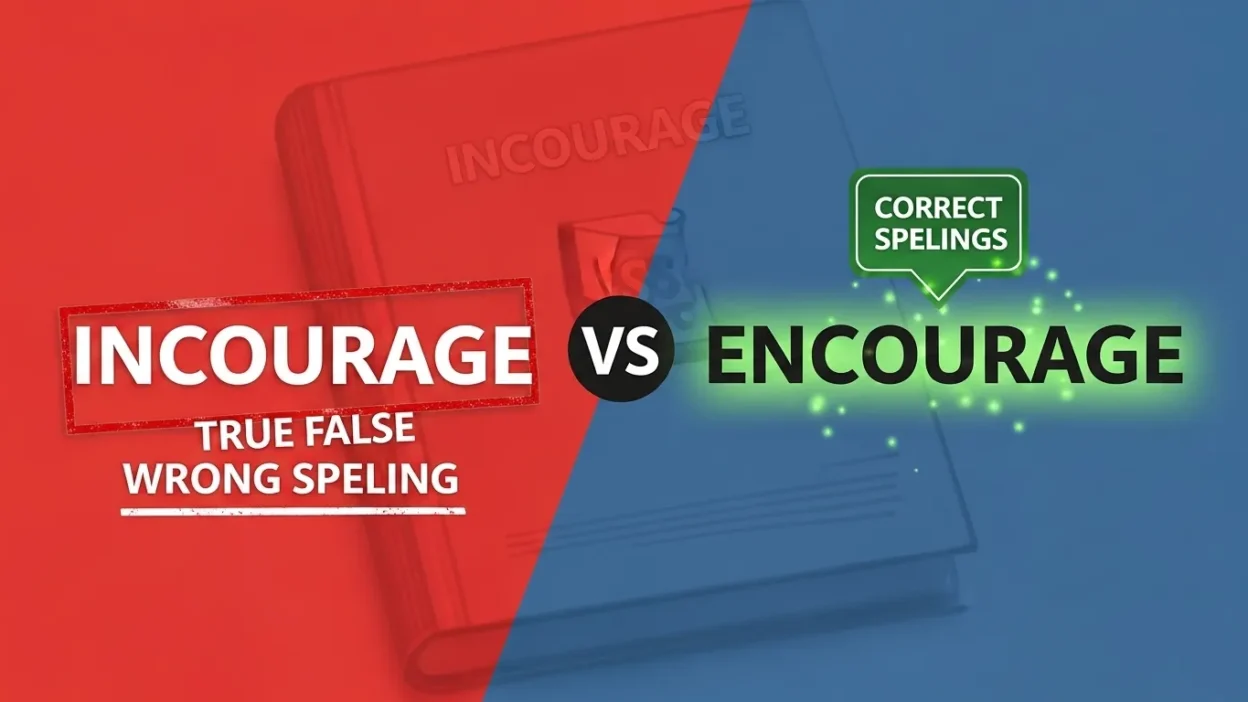
If you’ve ever paused mid-sentence wondering whether to write incourage or encourage, you’re not alone. Spelling confusion is common especially with words that sound similar.
But when it comes to professional emails, academic writing, or SEO content, even small spelling mistakes can affect clarity and credibility.
In this guide, we’ll break down incourage vs encourage in a simple, friendly way. You’ll learn which spelling is correct, what the word actually means, how to use it properly in sentences, and how to avoid common mistakes.
Let’s clear this up once and for all.
Quick Answer:
The correct spelling is encourage.
“Incourage” is a misspelling and is not recognized as a correct word in English. Always use encourage in formal and informal writing.
What Does “Encourage” Mean?
The word encourage means to:
- Give support, confidence, or hope to someone
- Inspire someone to take action
- Motivate or urge someone positively
- Promote or foster something
It comes from Old French and ultimately from Latin roots meaning “to give heart.” When you encourage someone, you literally “put heart” into them.
Simple Definition
Encourage (verb): To give someone confidence, support, or motivation.
Pronunciation
Encourage is pronounced:
/ɪnˈkʌrɪdʒ/
Notice that it sounds like it starts with “in,” which is one reason people mistakenly write “incourage.”
Why Do People Write “Incourage”?
The confusion between incourage vs encourage usually happens because of pronunciation.
When we say “encourage” quickly, it can sound like:
“in-courage”
This leads many writers especially English learners to assume the spelling begins with in- instead of en-.
But in English, spelling doesn’t always perfectly match pronunciation. That’s why relying on sound alone can cause errors.
Is “Incourage” Ever Correct?
No.
“Incourage” is not a word in standard English. It does not appear in reputable dictionaries such as:
- Merriam-Webster
- Oxford English Dictionary
- Cambridge University Press
If you use “incourage” in formal writing, spell-check tools will flag it as incorrect.
Examples of “Encourage” in Sentences
To fully understand incourage vs encourage, it helps to see correct usage in real sentences.
Everyday Examples
- Teachers should encourage students to ask questions.
- I want to encourage you to follow your dreams.
- Parents often encourage healthy habits at home.
- The coach encouraged the team after their loss.
- We must encourage open communication at work.
Professional Writing Examples
- The company aims to encourage innovation among employees.
- Governments should encourage sustainable practices.
- Leaders must encourage collaboration within teams.
Notice how “encourage” fits naturally in both formal and informal contexts.
Common Mistakes Related to Encourage
Here are some common spelling and grammar mistakes people make:
1. Writing “Incourage” Instead of “Encourage”
❌ I want to incourage you.
✅ I want to encourage you.
2. Confusing It With “In Courage”
Sometimes writers mistakenly separate it:
❌ She spoke in courage.
(Unless you literally mean she spoke while being courageous, which is rare.)
3. Incorrect Verb Forms
Make sure to use proper verb forms:
- Encourage (base form)
- Encourages (present tense)
- Encouraged (past tense)
- Encouraging (present participle)
Example:
- She is encouraging her friend.
- They encouraged him yesterday.
Incourage vs Encourage: Comparison Table
| Feature | Incourage | Encourage |
| Correct spelling | ❌ No | ✅ Yes |
| Recognized in dictionary | ❌ No | ✅ Yes |
| Meaning | None | To support, motivate, inspire |
| Used in formal writing | ❌ Never | ✅ Always |
| Common mistake? | Yes | No |
This simple comparison makes it clear: only “encourage” is correct.
American vs British English: Any Difference?
Good news there is no difference between American and British English when it comes to “encourage.”
Both:
- United States English
- United Kingdom English
spell the word as encourage.
Unlike words such as “color/colour” or “organize/organise,” this spelling remains consistent across regions.
So whether you’re writing for a U.S., UK, Canadian, or Australian audience, always use encourage.
Synonyms and Related Words (LSI Keywords)
To improve your writing and avoid repetition, here are useful synonyms and related phrases:
- Motivate
- Inspire
- Support
- Uplift
- Boost confidence
- Promote
- Urge
- Cheer on
- Empower
- Foster growth
Example:
Instead of saying:
Teachers should encourage creativity.
You could write:
Teachers should foster creativity.
Teachers should inspire creative thinking.
Using synonyms improves readability and strengthens SEO naturally.
How to Remember the Correct Spelling
Here are a few memory tricks:
1. Think of “Energy”
Both energy and encourage start with “en-”.
2. Remember “Give Heart”
Encourage means “to give heart.”
The word starts with en-, not in-.
3. Use Spell-Check Tools
Modern tools like grammar checkers and word processors automatically flag “incourage” as an error.
If you’re creating blog content, professional emails, or academic papers, always proofread carefully.
Why Correct Spelling Matters
You might wonder: does one letter really matter?
Yes, it does.
Misspellings can:
- Reduce credibility
- Affect SEO rankings
- Distract readers
- Make writing look unprofessional
In digital content, search engines recognize correct spellings. Writing “incourage” instead of “encourage” may prevent your content from ranking properly.
Clear, accurate writing builds trust and trust builds authority.
FAQs
1. Is “incourage” a real word?
No, “incourage” is a misspelling. The correct word is “encourage.”
2. Why does “encourage” sound like it starts with “in”?
Because of pronunciation. The first syllable sounds like “in,” but the correct spelling begins with “en-.”
3. Is “encourage” a verb or a noun?
“Encourage” is a verb.
The noun form is encouragement.
Example:
- I encourage you. (verb)
- Thank you for your encouragement. (noun)
4. Are there any regional spelling differences?
No. Both American and British English spell it as “encourage.”
5. What is the past tense of encourage?
The past tense is encouraged.
Example:
- She encouraged her friend yesterday.
6. How can I avoid spelling mistakes like this?
- Use spell-check tools
- Read your writing aloud
- Practice commonly confused words
- Learn word origins
7. Is “encouraging” correct?
Yes. “Encouraging” is the present participle form.
Example:
- That’s very encouraging news.
8. What is the difference between encourage and motivate?
They are similar. “Encourage” often implies emotional support, while “motivate” can imply driving someone toward action. In many cases, they can be used interchangeably.
Final Summary:
When it comes to incourage vs encourage, the answer is simple. “Encourage” is the correct spelling, and “incourage” is a common but incorrect variation.
The confusion usually happens because of pronunciation, but standard English spelling clearly favors “encourage.”
Using the correct spelling strengthens your writing, builds trust with readers, and improves professionalism. If you’re writing an email, blog post, academic paper, or social media caption, always choose encourage.
Actionable Takeaway
From today onward, remember this rule:
If you want to inspire, support, or motivate someone, use encourage, never “incourage.”
Add the word to your frequently reviewed spelling list, double-check your drafts, and use reliable proofreading tools. Clear, confident writing begins with small details and mastering words like this makes a big difference.

Mia Elizabeth is a contributing author at SpellPeak, passionate about thoughtful writing and clear communication. She creates engaging, well-researched content that helps readers learn and connect with ideas easily. Her work emphasizes clarity, creativity, and practical value, supporting meaningful digital experiences and accessible knowledge sharing worldwide.