If you’ve ever typed “havnt” or “havent” and paused for a second, wondering if it looks right you’re not alone. These tiny spelling details can feel confusing, especially when typing quickly on your phone or laptop.
But when it comes to correct English spelling, even one missing apostrophe can make a difference.
In this guide, we’ll break down havnt vs havent, explain which one is correct (and why), share clear examples, and help you avoid common grammar mistakes in the future.
If you’re writing an email, an academic paper, or a social media caption, this quick lesson will boost your confidence and polish your writing.
Quick Answer:
Neither “havnt” nor “havent” is correct in standard English.
The correct spelling is “haven’t” with an apostrophe.
“Haven’t” is the contraction of “have not.” The apostrophe replaces the missing letter “o” in “not.”
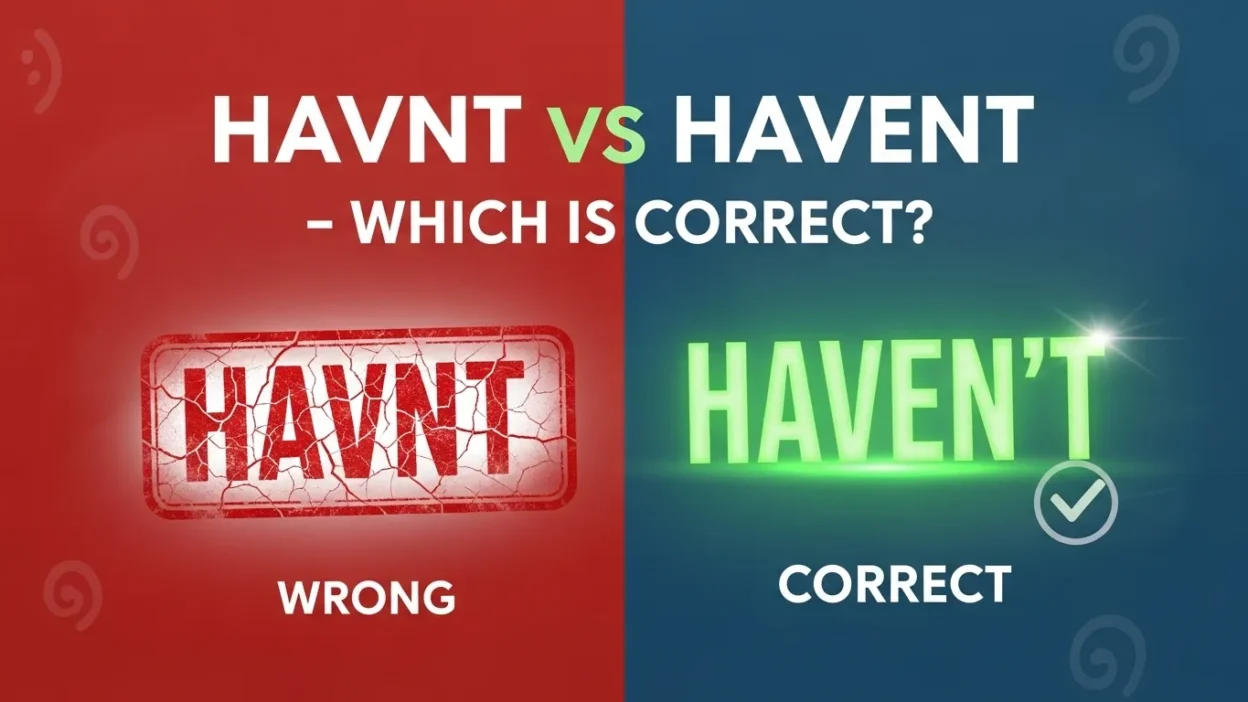
❌ Havnt
❌ Havent
✅ Haven’t
If you remember one thing from this article, let it be this: Always use the apostrophe in “haven’t.”
What Does “Haven’t” Mean?
“Haven’t” is a contraction of “have not.” It is used in present perfect tense and in negative statements.
For example:
- I haven’t finished my homework.
- They haven’t arrived yet.
- We haven’t seen that movie.
In each sentence, “haven’t” simply means “have not.”
Contractions like “haven’t,” “don’t,” and “can’t” are common in everyday English writing and speech. They make language sound natural and conversational.
Why “Havnt” and “Havent” Are Incorrect
Let’s break it down clearly.
1. “Havnt” Is Missing Two Letters
“Havnt” removes both the letter “e” and the apostrophe. That’s not how English contractions work. When shortening “have not,” only the “o” is removed and replaced with an apostrophe.
Correct pattern:
- Have not → Haven’t
Incorrect pattern:
- Have not → Havnt ❌
2. “Havent” Is Missing the Apostrophe
“Havent” looks closer to correct, but it still isn’t standard English. Without the apostrophe, it’s considered a spelling error.
In English grammar rules, apostrophes are essential in contractions. Writing “havent” instead of “haven’t” is grammatically incorrect in formal and informal writing.
Havnt vs Havent vs Haven’t: Comparison Table
| Word | Correct? | Why? |
| Havnt | ❌ No | Missing “e” and apostrophe |
| Havent | ❌ No | Missing apostrophe |
| Haven’t | ✅ Yes | Correct contraction of “have not” |
When comparing havnt vs havent, both are incorrect. Only “haven’t” is correct.
Examples of “Haven’t” in Sentences
Here are more real-world examples to help you understand usage:
- I haven’t eaten breakfast yet.
- She hasn’t called, but I haven’t forgotten.
- We haven’t decided on a date.
- You haven’t told me the truth.
- They haven’t completed the project.
Notice that “haven’t” is used with I, you, we, and they.
For “he,” “she,” and “it,” we use “hasn’t.”
For example:
- He hasn’t finished.
- She hasn’t replied.
Understanding subject-verb agreement helps prevent grammar mistakes.
Common Mistakes People Make
Let’s look at why people often confuse havnt vs havent.
1. Typing Too Fast
Many spelling errors happen because of quick typing. Apostrophes are easy to forget, especially on mobile keyboards.
2. Autocorrect Issues
Sometimes autocorrect doesn’t catch missing apostrophes. It may allow “havent” to slip through.
3. Informal Texting Habits
In casual messaging, people often drop punctuation. But in professional writing, correct spelling matters.
4. Confusion About Contractions
Some learners of English aren’t sure how contractions are formed. Remember this simple rule:
If two words combine and letters are removed, use an apostrophe.
Examples:
- Do not → Don’t
- Can not → Can’t
- Will not → Won’t
- Have not → Haven’t
American vs British English: Is There Any Difference?
Good news: There is no difference between American and British English when it comes to “haven’t.”
Both use:
- Haven’t (correct)
- Havent (incorrect)
- Havnt (incorrect)
Whether you’re writing in the United States, the United Kingdom, Australia, Canada, or anywhere else, the spelling rule stays the same.
Why Correct Spelling Matters
You might wonder: does one missing apostrophe really matter?
Yes, it does.
Correct spelling:
- Builds credibility
- Improves readability
- Enhances professionalism
- Helps with academic writing
- Strengthens SEO content quality
If you’re creating content for websites or blogs, spelling accuracy also supports trustworthiness and aligns with Google’s E-E-A-T principles (Experience, Expertise, Authoritativeness, and Trustworthiness).
Small grammar details signal attention to quality.
Grammar Tip: When to Use “Haven’t”
Use “haven’t” in these situations:
Present Perfect Tense
Structure: Subject + have not + past participle
Examples:
- I haven’t finished.
- They haven’t started.
- We haven’t traveled abroad.
Negative Questions
- Haven’t you heard?
- Haven’t they arrived yet?
These forms are common in both spoken and written English.
How to Remember the Correct Spelling
Here’s a simple memory trick:
“Haven’t” has an apostrophe because something is missing.
The missing letter is “o” from “not.”
Think of it like this:
Have not → Haven’t (the “o” is replaced by ’)
If you don’t see an apostrophe, it’s wrong.
You can also proofread by expanding it:
If you can replace the word with “have not” and the sentence still makes sense, use “haven’t.”
Example:
- I haven’t seen it.
- I have not seen it. ✅
Related Grammar Confusions
If you struggle with havnt vs havent, you might also find these confusing:
- Dont vs Don’t
- Cant vs Can’t
- Shouldnt vs Shouldn’t
- Couldnt vs Couldn’t
- Wouldnt vs Wouldn’t
The rule is always the same: contractions need apostrophes.
FAQs
1. Is “havnt” ever correct?
No, “havnt” is never correct in standard English spelling.
2. Can I use “havent” in informal texting?
While some people use it casually, it is still technically incorrect. In professional or academic writing, always use “haven’t.”
3. Why is there an apostrophe in “haven’t”?
The apostrophe replaces the missing letter “o” from “not” in the contraction “have not.”
4. What is the difference between “haven’t” and “hasn’t”?
“Haven’t” is used with I, you, we, and they.
“Hasn’t” is used with he, she, and it.
5. Is “haven’t” used in British English?
Yes. Both American and British English use “haven’t” the same way.
6. Is it okay to avoid contractions completely?
Yes. In very formal writing, you can use “have not” instead of “haven’t.” Both are grammatically correct.
7. Why do spellcheck tools sometimes miss “havent”?
Some tools focus on dictionary words and may not flag missing punctuation clearly. Always proofread carefully.
Final Summary:
When comparing havnt vs havent, the truth is simple: neither spelling is correct. The only correct form is “haven’t.” It includes an apostrophe because it’s a contraction of “have not.”
Although the mistake seems small, proper spelling improves clarity, professionalism, and credibility.
If you’re writing emails, blog posts, assignments, or social media captions, using correct contractions shows attention to detail and strong language skills.
Actionable Takeaway
From now on, whenever you type “havent” or “havnt,” pause and check for the apostrophe. If you mean “have not,” always write “haven’t.”
Make it a habit to proofread contractions carefully. Over time, correct spelling becomes automatic and your writing will feel smoother, clearer, and more polished.

Matthew Benjamin is a contributing author at SpellPeak, dedicated to clear, engaging, and purposeful writing. He focuses on creating informative content that helps readers understand complex ideas with ease. His work emphasizes accuracy, creativity, and practical value, supporting better communication and thoughtful digital learning for a global audience.