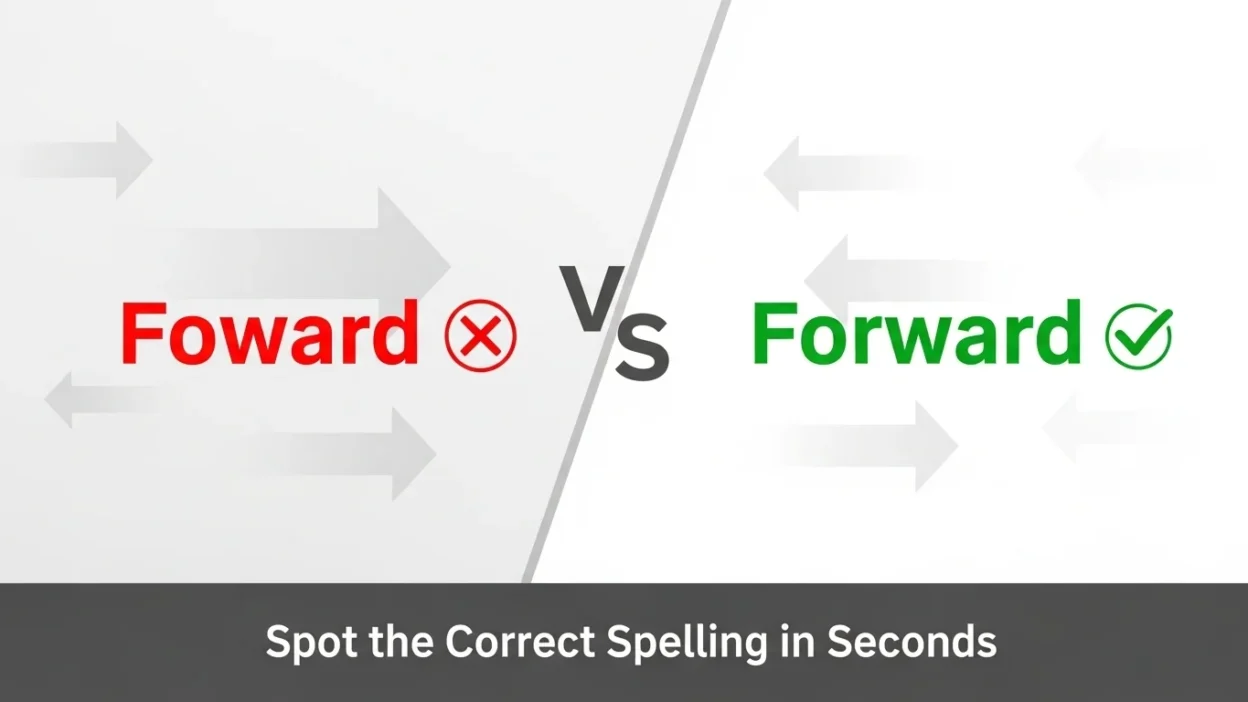
Many English learners and even native speakers often get confused between foward and forward. At first glance, the words look very similar, which makes the mistake easy to overlook when writing emails, essays, or online content. However, one of these spellings is correct, while the other is simply a common misspelling.
Understanding the difference between foward vs forward can help you write more confidently and avoid embarrassing spelling mistakes. In this guide, we’ll explain the correct spelling, meanings, examples, common errors, and helpful tips so you can always choose the right word.
Quick Answer
- Forward is the correct spelling in English.
- Foward is a misspelling and should not be used.
Example:
✔ I look forward to meeting you.
✘ I look foward to meeting you.
In short, whenever you want to describe movement ahead, progress, or sending something onward, the correct word is forward.
What Does “Forward” Mean?
The word forward is a versatile term in English and can function as an adjective, adverb, verb, or noun depending on the sentence.
Generally, forward means:
- Moving toward the front
- Advancing or progressing
- Sending something to another person
- Positioned ahead in time or space
Examples of “Forward” in Sentences
Here are a few simple examples:
- She stepped forward to ask a question.
- Please forward this email to the manager.
- The company is moving forward with its new project.
- He leaned forward to hear better.
In each example, the word suggests movement, progress, or passing something along.
Why Do People Write “Foward”?
The spelling foward is usually a typing or spelling mistake. It happens because people accidentally drop the letter “r” when writing the word quickly.
Common reasons include:
- Fast typing errors
- Autocorrect mistakes
- Mispronunciation when learning English
- Lack of proofreading
Since forward contains the letter sequence “rwa”, some writers skip the r without realizing it.
However, in standard English dictionaries, foward does not exist as a correct word.
Foward vs Forward: Key Differences
Here is a quick comparison to make things clearer.
| Word | Correct or Incorrect | Meaning | Example |
| Forward | Correct spelling | Moving ahead, sending onward, progressing | I look forward to the weekend. |
| Foward | Incorrect spelling | No valid meaning | This is a spelling mistake. |
The table makes it simple: always choose “forward.”
Common Situations Where “Forward” Is Used
The word forward appears in many everyday situations. Here are some of the most common ones.
1. Expressing Anticipation
One of the most common phrases is:
“I look forward to…”
Example:
- I look forward to hearing from you.
- We look forward to working together.
This phrase expresses excitement or anticipation about the future.
2. Sending Emails or Messages
In digital communication, forward means sending a message to another person.
Example:
- Please forward this email to the support team.
- Can you forward the document to me?
3. Physical Movement
The word can also describe physical movement toward the front.
Example:
- The crowd moved forward slowly.
- She stepped forward confidently.
4. Progress or Development
It may also represent progress or advancement.
Example:
- Science continues to move forward every year.
- The project is finally moving forward.
Common Mistakes With “Forward”
Even though the correct spelling is simple, many writers still make mistakes. Here are the most frequent ones.
1. Dropping the Letter “R”
Incorrect:
- I look foward to meeting you.
Correct:
- I look forward to meeting you.
2. Confusing “Forward” and “Forwards”
Both words are correct but used slightly differently.
Example:
- Move forward.
- Move forwards slowly.
In American English, forward is more common, while forwards is often used in British English.
3. Using It Incorrectly in Emails
Many professional emails include the phrase:
✔ I look forward to your reply.
But some people mistakenly write:
✘ I look foward to your reply.
This small spelling error can make writing look unprofessional.
American vs British English Differences
In most cases, forward is used in both American and British English. However, there are small variations.
American English
American English usually prefers forward without an s.
Example:
- Move forward carefully.
- The team pushed forward.
British English
British English sometimes uses forwards, especially as an adverb.
Example:
- She stepped forwards quickly.
Even so, forward is still widely accepted in British English as well.
Tips to Remember the Correct Spelling
If you struggle to remember the correct spelling, these tips can help.
1. Remember the Word “Word” Inside It
Forword
Seeing word inside and forward can help you remember the spelling.
2. Think of “For + Ward”
Break the word into two parts:
for + ward = forward
3. Use Spell Check
Modern writing tools automatically highlight foward as incorrect.
4. Proofread Carefully
A quick reread can catch small spelling mistakes.
Similar Words Related to “Forward”
Learning related words can also strengthen your vocabulary.
Some similar terms include:
- ahead
- onward
- advance
- progress
- proceed
- continue
Example:
- The team moved ahead with the plan.
- Let’s advance to the next step.
These words share a similar idea of movement or progress.
FAQs
1. Is “foward” ever correct?
No. Foward is not a recognized English word. It is simply a misspelling of forward.
2. Why do people spell forward as foward?
This mistake usually happens because writers accidentally skip the letter “r” while typing.
3. Is forward a noun or verb?
Forward can be multiple parts of speech, including:
- noun
- verb
- adjective
- adverb
Example:
Please forward the message. (verb)
4. What does “look forward to” mean?
It means to feel excited or happy about something that will happen in the future.
Example:
I look forward to the holidays.
5. Is “forward” used in emails?
Yes. It is very common in professional communication.
Example:
Please forward this email to the marketing team.
6. Is “forwards” wrong?
No. Forwards is correct, especially in British English, but forward is more common globally.
7. How can I remember the correct spelling?
Think of the phrase “look forward to.” Seeing it often helps reinforce the correct spelling.
Summary
Understanding the difference between foward vs forward is simple once you know the rule. Forward is the correct spelling used in all forms of English, while foward is only a common spelling mistake.
The word forward can describe movement, progress, anticipation, or sending something to another person. By remembering the correct spelling and proofreading your writing, you can avoid this error and communicate more clearly.
If you’re writing emails, academic work, or online content, using forward correctly will make your writing look more professional and polished.
Actionable takeaway:
Whenever you write the word, pause and check the spelling—forward always includes the letter “r” after “fo.”

Noah Jacob is the administrator of SpellPeak, responsible for managing website operations, content coordination, and platform performance. He ensures smooth functionality, security, and reliability while supporting the team in delivering a seamless, user-focused experience and maintaining high standards of quality across the site.