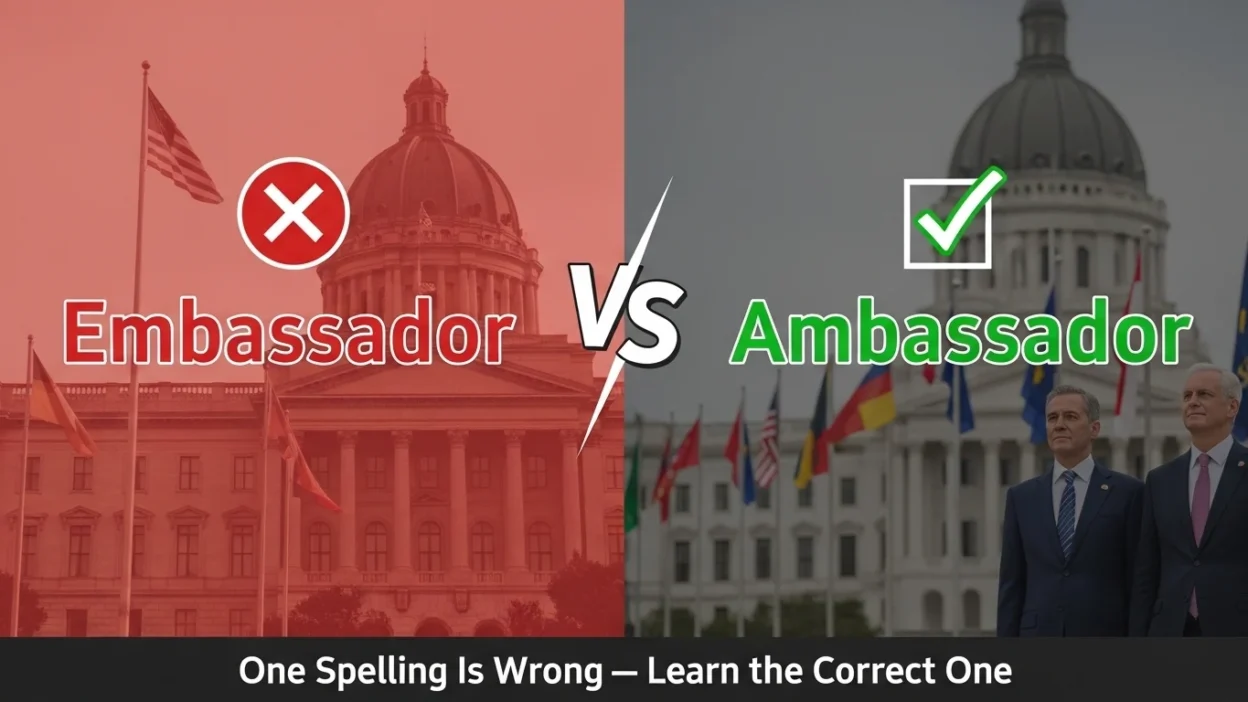
Spelling mistakes happen to everyone especially when two words look almost identical. One common confusion many writers and students face is embassador vs ambassador. At first glance, both spellings seem reasonable, but only one is actually correct in standard English.
If you’ve ever wondered whether embassador is acceptable or if ambassador is the only correct spelling, you’re not alone. In this guide, we’ll explain the meaning, correct spelling, examples, common mistakes, and how to remember the right word easily. By the end, you’ll confidently know which spelling to use every time.
Quick Answer
The correct spelling is ambassador.
Embassador is a common misspelling and is not recognized as a standard English word.
- ✅ Correct: Ambassador
- ❌ Incorrect: Embassador
An ambassador is a person who represents a country, organization, or brand officially.
Example:
- She was appointed ambassador to France.
- He became a brand ambassador for a global company.
What Does “Ambassador” Mean?
The word ambassador refers to a person who represents someone else or something officially. It is most commonly used in diplomacy but is also used in business and marketing.
Main meanings of ambassador:
1. Diplomatic representative
An ambassador is the highest-ranking diplomat representing a country in another nation.
Example:
- The ambassador met with government officials to discuss trade relations.
2. Brand or promotional representative
Companies often choose celebrities or influencers as brand ambassadors.
Example:
- The athlete became a global brand ambassador for the sportswear company.
3. Representative of a cause or idea
Sometimes the word is used more generally for someone promoting a mission or message.
Example:
- She acts as an ambassador for environmental awareness.
Why “Embassador” Is Incorrect
The spelling embassador is simply a mistake caused by pronunciation confusion.
Many people hear the word spoken and assume it begins with “em”, but the correct prefix is “am”. English spelling often preserves historical roots, which is why the spelling remains ambassador.
Reasons people write embassador:
- Pronunciation confusion
- Typing errors
- Lack of familiarity with the correct spelling
- Influence of phonetic spelling
However, dictionaries and style guides do not recognize embassador as correct.
Origin of the Word “Ambassador”
Understanding the origin can make the spelling easier to remember.
The word ambassador comes from:
- Old French: ambassadeur
- Italian: ambasciatore
- Latin roots related to service or mission
Historically, an ambassador was someone sent on a mission to represent a ruler or government.
Because of this long linguistic history, the spelling has stayed consistent as ambassador, not embassador.
Embassador vs Ambassador: Comparison Table
| Feature | Embassador | Ambassador |
| Spelling status | Incorrect | Correct |
| Dictionary recognition | Not recognized | Recognized worldwide |
| Meaning | None | Official representative |
| Usage in writing | Considered a typo | Standard English |
| Acceptable in formal writing | No | Yes |
In short, ambassador is the only correct spelling to use in academic, professional, or everyday writing.
Examples of Ambassador in Sentences
Here are several real-world examples showing how ambassador is used correctly.
Diplomatic context
- The ambassador attended the international peace conference.
- The country appointed a new ambassador to Japan.
Business and marketing
- She became the brand ambassador for the cosmetics company.
- The singer serves as a tourism ambassador for her country.
Social causes
- He works as a youth ambassador for climate change awareness.
- The organization chose students as cultural ambassadors.
Notice that the spelling always remains ambassador.
Common Mistakes People Make
Many writers accidentally type embassador. Here are some common situations where the mistake appears.
1. Phonetic spelling
People write the word the way it sounds.
Incorrect:
- He was named the company’s embassador.
Correct:
- He was named the company’s ambassador.
2. Fast typing errors
When typing quickly, the first letter may change unintentionally.
Incorrect:
- She is the youth embassador of the program.
Correct:
- She is the youth ambassador of the program.
3. Social media spelling habits
Informal writing online sometimes spreads incorrect spellings.
Even on social media, it’s best to use ambassador to maintain credibility.
American vs British English Differences
Interestingly, there is no spelling difference between American and British English for this word.
Both versions use:
- Ambassador (correct)
- Embassador (incorrect)
So whether you’re writing for American or British audiences, the spelling remains the same.
Tips to Remember the Correct Spelling
If you struggle with embassador vs ambassador, these simple tricks can help.
1. Remember “Am” for America
Many ambassadors represent their countries abroad.
Think: Ambassador → America sends ambassadors.
2. Connect it with “ambition”
Both start with amb.
Ambition → Ambassador
3. Think of “amb”
Many English words begin with amb:
- Ambition
- Ambition
- Ambient
- Ambassador
This pattern helps reinforce the correct spelling.
When the Word “Ambassador” Is Used Today
Today, the word is used in several modern contexts beyond politics.
Diplomatic ambassadors
Official government representatives in foreign countries.
Brand ambassadors
Influencers or celebrities promoting products.
Campus ambassadors
Students representing companies or organizations at universities.
Cultural ambassadors
Individuals promoting cultural exchange and understanding.
Despite these different uses, the spelling remains ambassador.
FAQs
1. Is embassador a real word?
No. Embassador is a misspelling and is not recognized in standard English dictionaries.
2. What is the correct spelling: embassador or ambassador?
The correct spelling is ambassador.
3. What does ambassador mean?
An ambassador is a person who represents a country, organization, brand, or cause.
4. Why do people write embassador?
People often write embassador because of pronunciation confusion or typing errors.
5. Is ambassador used only in politics?
No. It is also used in marketing, education, tourism, and social campaigns.
Examples include:
- brand ambassador
- campus ambassador
- tourism ambassador
6. Is ambassador the same in British and American English?
Yes. Both British and American English use the same spelling: ambassador.
7. What is a brand ambassador?
A brand ambassador is a person hired or chosen to promote and represent a company’s brand.
8. How can I remember the correct spelling?
Remember that the word begins with “amb”, just like ambition.
Summary
The confusion between embassador vs ambassador is common, but the answer is simple. The correct spelling is ambassador, and embassador is a misspelling that should be avoided in all forms of writing.
The word refers to someone who represents a country, organization, or brand officially, and it is widely used in diplomacy, business, and public relations.
To avoid mistakes, remember that the word starts with “amb”, not “em.” This spelling is consistent across American and British English.
If you are writing about diplomats, brand ambassadors, or social advocates, always use the correct form ambassador.
Actionable takeaway:
Whenever you’re unsure about the spelling, think of related words like ambition or ambient. If the word starts with amb, you’re on the right track.

Mia Elizabeth is a contributing author at SpellPeak, passionate about thoughtful writing and clear communication. She creates engaging, well-researched content that helps readers learn and connect with ideas easily. Her work emphasizes clarity, creativity, and practical value, supporting meaningful digital experiences and accessible knowledge sharing worldwide.