If you’ve ever paused mid-sentence wondering whether to write ect or etc, you’re definitely not alone. This is one of the most common spelling mix-ups in everyday writing especially in emails, assignments, and social media posts.
The good news? Once you understand the difference between ect vs etc, you’ll never make this mistake again. In this guide, we’ll break it down in a clear, friendly way so you can feel confident using the correct form every time.
Quick Answer
- ✅ Correct: etc.
- ❌ Incorrect: ect
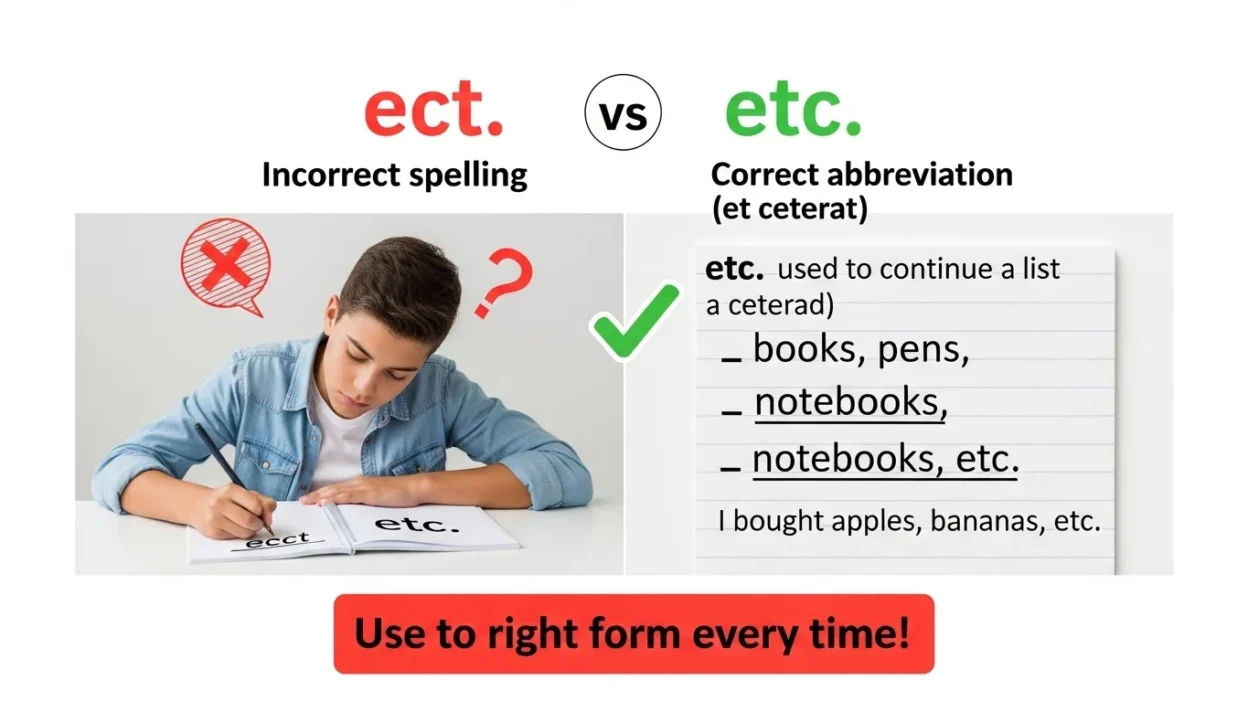
“Etc.” is the correct abbreviation of the Latin phrase et cetera, meaning “and other similar things.”
“Ect” is simply a common spelling mistake and has no meaning in standard English.
What Does “Etc.” Mean?
The term etc. comes from the Latin phrase et cetera, which translates to “and the rest” or “and so on.”
It’s used when you want to continue a list without writing everything out.
Simple Examples:
- I bought apples, oranges, bananas, etc.
- Bring your notebooks, pens, pencils, etc. to class.
- We talked about movies, music, travel, etc.
👉 In each case, etc. replaces additional similar items in a list.
Why Do People Write “Ect”?
The confusion around ect vs etc usually comes from how we pronounce words. When spoken quickly, “etc.” can sound like “ek-set-ra” or even “ek-t,” leading people to mistakenly write ect.
Common Reasons for the Mistake:
- Mishearing the pronunciation
- Typing too quickly
- Not knowing the Latin origin
- Assuming phonetic spelling is correct
But remember: “ect” is always incorrect in standard writing.
Ect vs Etc: Key Differences
Here’s a quick comparison to make things crystal clear:
| Feature | Etc. | Ect |
| Meaning | “And so on” / “and others” | No meaning |
| Usage | Correct in all writing | Incorrect |
| Origin | Latin (et cetera) | Not a real word |
| Formal Writing | Accepted and widely used | Not accepted |
How to Use “Etc.” Correctly
Using etc. properly can make your writing smoother and more concise. But it should be used thoughtfully.
Best Practices:
- Use it at the end of a list
- Avoid overusing it in formal writing
- Don’t use it after phrases like “such as” or “including” (redundant)
Correct Usage:
- We need chairs, tables, decorations, etc.
- He enjoys hiking, swimming, cycling, etc.
Incorrect Usage:
- We need items such as chairs, tables, decorations, etc. ❌
✔ Better: We need items such as chairs, tables, and decorations.
Common Mistakes to Avoid
When dealing with ect vs etc, here are the most frequent errors people make:
1. Writing “ect” Instead of “etc.”
- ❌ I like tea, coffee, juice, ect
- ✅ I like tea, coffee, juice, etc.
2. Overusing “etc.”
Using it too often can make your writing vague.
- ❌ She bought clothes, shoes, bags, etc., etc.
- ✅ She bought clothes, shoes, and bags.
3. Using “etc.” with Specific Lists
Avoid it when your list is already clear and complete.
4. Forgetting the Period
Since it’s an abbreviation, etc. should always include a period.
- ❌ etc
- ✅ etc.
American vs British English Usage
When it comes to etc., there’s actually very little difference between American and British English.
Similarities:
- Both use etc. with a period
- Same meaning and usage rules
- Same pronunciation variations
Slight Style Differences:
- In very formal British writing, people may avoid abbreviations like etc. and prefer writing and so on
- American English tends to use etc. more freely in casual and semi-formal contexts
👉 Overall, etc. is universally accepted in both varieties of English.
When NOT to Use “Etc.”
Even though etc. is useful, there are situations where it’s better to avoid it:
- In academic or formal writing (use complete lists instead)
- When clarity is important
- When the list is short and specific
- When it sounds repetitive or lazy
Better Alternatives:
- and so on
- and others
- and more
- among others
Helpful Memory Trick
Here’s an easy way to remember:
👉 “Etc.” = “Et Cetera” = “Extra things continue”
If you remember that it stands for something longer, you’ll be less likely to write ect.
FAQs
1. Is “ect” ever correct?
No, ect is never correct in standard English. It’s always a misspelling of etc.
2. What does “etc.” stand for?
It stands for the Latin phrase et cetera, meaning “and other similar things.”
3. Can I use “etc.” in formal writing?
Yes, but use it sparingly. In very formal or academic writing, it’s better to list items fully.
4. Should I always add a period after “etc.”?
Yes, because it’s an abbreviation. Always write etc.
5. Can I use “etc.” in the middle of a sentence?
It’s usually placed at the end of a list, but it can appear mid-sentence if the structure allows it.
6. Is it okay to use “and etc.” together?
No, that’s incorrect. Since etc. already means “and the rest,” adding “and” is redundant.
7. What are alternatives to “etc.”?
You can use and so on, and others, and more, or simply complete the list.
8. Why is “etc.” so commonly miswritten?
Because of pronunciation confusion and lack of awareness about its Latin origin.
Final Thoughts
Understanding the difference between ect vs etc is simple once you know the rule: “etc.” is correct, and “ect” is always a mistake. This small detail can make a big difference in how polished and professional your writing appears.
By using etc. properly and only when needed you can keep your writing clear, concise, and natural. It’s not about memorizing rules; it’s about building confidence in your everyday communication.
Actionable Takeaway
From now on, whenever you’re tempted to write ect, pause and replace it with etc.. Practice using it in short lists and double-check your writing before publishing or sending messages.
A simple habit like this can instantly improve your grammar and leave a better impression whether you’re writing emails, blog posts, or social media content.

Matthew Benjamin is a contributing author at SpellPeak, dedicated to clear, engaging, and purposeful writing. He focuses on creating informative content that helps readers understand complex ideas with ease. His work emphasizes accuracy, creativity, and practical value, supporting better communication and thoughtful digital learning for a global audience.