
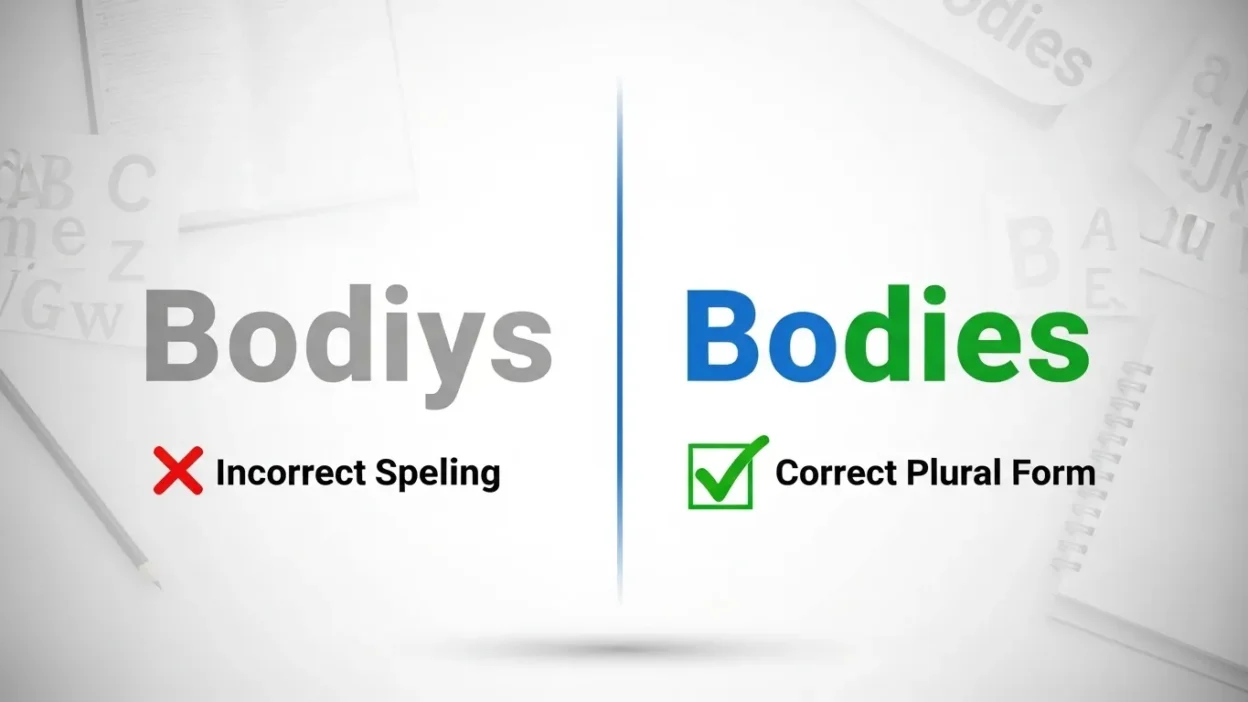
Are you confused about whether to use bodies or bodys? You’re not alone. Many English learners and even native speakers stumble when it comes to plural forms of certain words.
Choosing the right word can affect not only grammar but also clarity in writing, emails, and even social media posts.
In this article, we’ll break down the differences between bodies and bodys, explain common mistakes, and give you clear examples.
By the end, you’ll confidently know which form to use and why it matters in both American and British English.
Quick Answer
Correct plural form: bodies
Incorrect form: bodys
Why: In English, words ending with a “y” preceded by a consonant change the “y” to “i” and add “es” to form the plural. Words ending with a vowel + y simply add an “s.”
Example:
- One body → Two bodies
- One boy → Two boys
Using bodys is always incorrect in standard English.
What “Bodies” Means
The word body generally refers to the physical form of a human or animal. It can also describe the main part of something, like a body of text or a body of water.
Examples:
- The human body is made up of bones, muscles, and organs.
- Police found two bodies near the lake.
- A well-written article has a strong body that supports the introduction.
In all plural contexts, always use bodies, not bodys.
Common Mistakes
Many learners mistakenly write bodys because they try to simply add an “s” to make a plural. This happens when:
- The word ends with a consonant + y
- Writers are unsure of the plural rule
- Typing quickly leads to oversight
Incorrect: The doctors examined the bodys carefully.
Correct: The doctors examined the bodies carefully.
Other words with similar patterns include:
- City → Cities
- Party → Parties
- Baby → Babies
Notice how the “y” changes to “i” before adding -es in each plural form.
Bodies vs Bodys Table: Quick Comparison
| Aspect | Bodies | Bodys |
| Correct Usage | ✅ Standard plural of “body” | ❌ Incorrect form |
| Grammar Rule | “y” after consonant → “i” + “es” | N/A |
| Examples | Two bodies, several bodies | Two bodys (wrong) |
| Common Confusion | Mistaken for regular “add s” rule | Always incorrect |
| American vs British English | Same usage in both | N/A |
American vs British English
Good news: Both American and British English follow the same rule for body → bodies. There is no variant bodys in either version. So no matter which side of the Atlantic you’re on, bodies are the right choice.
FAQs
1. Can I ever use “bodys”?
No. “Bodys” is always considered incorrect in formal and informal English.
2. Is “bodies” used only for humans?
No. It can refer to animals, objects, or even abstract things like a “body of evidence.”
3. Why does the “y” change to “i”?
This is a standard English pluralization rule: consonant + y → change y to i and add -es.
4. Are there exceptions to this rule?
Yes, if the “y” follows a vowel, simply add an “s.” For example: boy → boys, key → keys.
5. Does this apply to American and British English alike?
Yes, both varieties use bodies. There’s no regional variation here.
6. How can I remember this rule easily?
Think of other words like city → cities or baby → babies. Patterns help.
7. What about words like “lady”?
The same rule applies: lady → ladies. If consonant + y, change to i + es.
8. Can spellcheck catch “bodys”?
Most modern spellcheckers will flag it as incorrect, but always double-check in context.
Examples in Sentences
- The museum displayed ancient human bodies preserved in ice.
- Several bodies of water surround the island.
- Police recovered three bodies from the accident site.
- The article’s body explains the main ideas clearly.
- Yoga helps you maintain a healthy body and mind.
Notice how versatile the body/bodies can be depending on context.
Actionable Takeaways
- Always change consonant + y to i + es for plurals: body → bodies.
- Avoid the incorrect bodys it’s never acceptable.
- Use spellcheck and proofread for quick errors, especially in writing exams or professional emails.
- Keep examples in mind: baby → babies, city → cities, body → bodies.
- Recognize context: bodies can refer to people, animals, or objects.
By internalizing this rule, you’ll never confuse bodies with bodys, and your writing will be grammatically accurate and clear.
Summary
Understanding bodies vs bodys is simpler than it looks. Remember the rule: if a word ends with a consonant + y, switch the “y” to “i” and add -es to make it plural.
Bodies is the only correct form in standard English, whether you’re writing in American or British style. By mastering this small but important rule, you’ll avoid common mistakes, sound more confident in writing, and make your content clear and professional.
Keep practicing with similar words to reinforce the pattern, and soon it will become second nature.

Matthew Benjamin is a contributing author at SpellPeak, dedicated to clear, engaging, and purposeful writing. He focuses on creating informative content that helps readers understand complex ideas with ease. His work emphasizes accuracy, creativity, and practical value, supporting better communication and thoughtful digital learning for a global audience.