If you’ve ever typed affort when you meant effort, you’re not alone. This is a very common spelling mistake, especially for English learners and even native speakers who type quickly. The two words look similar, sound similar, but only one of them is actually correct in English.
In this guide, we’ll clearly explain affort vs effort, their meaning, examples, common mistakes, and how to remember the correct spelling easily. By the end, you’ll never confuse these two again.
Quick Answer
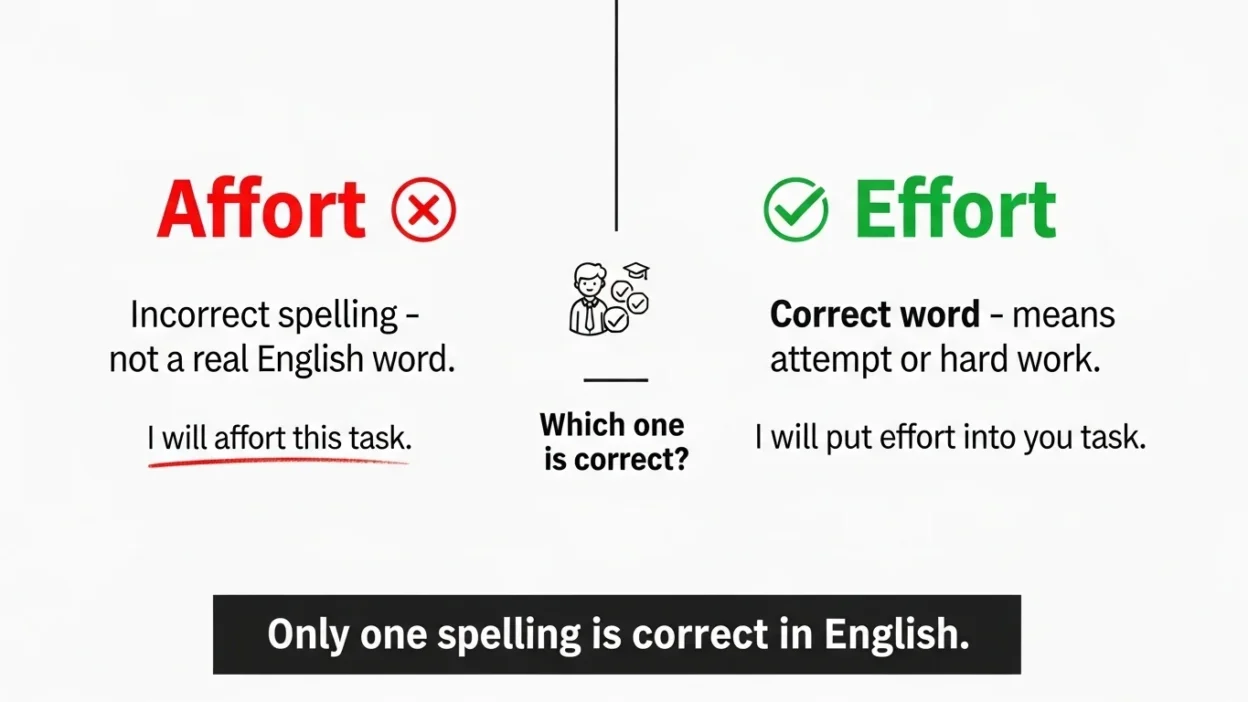
Effort is the correct word and means physical or mental energy used to do something.
Affort is not a correct English word. It is a misspelling of effort.
Correct: She put a lot of effort into her work.
Incorrect: She put a lot of affort into her work.
Meaning of Effort
The word effort is a noun that means the energy, work, or attempt you put into doing something. It can be physical effort, mental effort, or emotional effort.
Examples of Effort in Sentences
- He made a big effort to finish the project on time.
- Learning English requires daily effort.
- She put a lot of effort into improving her writing skills.
- The team’s effort helped them win the match.
- Thank you for your effort and hard work.
Synonyms of Effort (LSI Keywords):
- Hard work
- Attempt
- Try
- Energy
- Struggle
- Work
- Exertion
- Dedication
- Commitment
Why Do People Write “Affort” Instead of Effort?
The mistake happens because of pronunciation. When we speak fast, effort sometimes sounds like affort, which leads to spelling confusion.
Common Reasons for This Mistake:
- Pronunciation confusion
- Typing error
- Lack of spelling knowledge
- English is not first language
- Autocorrect mistakes
But remember this simple rule:
There is no word “affort” in English. The correct spelling is always effort.
Affort vs Effort: Comparison Table
| Word | Correct or Incorrect | Meaning | Example |
| Affort | Incorrect ❌ | No meaning | Wrong spelling |
| Effort | Correct ✅ | Hard work or energy | She made an effort |
This table makes it very clear: Only effort is a real word.
Common Mistakes with Effort
Here are some common spelling mistakes people make:
- Affort ❌
- Efert ❌
- Effert ❌
- Efort ❌
- Effort ✅ (Correct spelling)
Wrong vs Correct Examples
- ❌ I appreciate your affort.
- ✅ I appreciate your effort.
- ❌ He didn’t make any affort.
- ✅ He didn’t make any effort.
- ❌ Without affort, success is impossible.
- ✅ Without effort, success is impossible.
American vs British English
Good news: Effort is spelled the same in both American English and British English. There is no difference in spelling or meaning.
| American English | British English |
| Effort | Effort |
So you don’t need to worry about US vs UK spelling for this word.
How to Remember the Correct Spelling
Here are some easy memory tips:
Memory Trick 1
Effort starts with “EF” like “Energy + Focus” → EF → Effort
Memory Trick 2
Think of this sentence:
Effort = Energy For Finding Success
Memory Trick 3
Remember:
Affort = Always A wrong spelling
Effort = English Eorrect word
These simple tricks help you remember the correct spelling easily.
When to Use Effort
Use effort when talking about:
- Hard work
- Trying
- Practice
- Studying
- Improvement
- Physical work
- Mental work
Example Sentences
- Success comes from continuous effort.
- She is making an effort to learn new skills.
- Your effort matters more than your talent.
- The company appreciates employee effort.
- He put great effort into his presentation.
Effort in Common Phrases
Here are common English phrases that use the word effort:
- Make an effort
- Best effort
- Great effort
- Team effort
- Extra effort
- Without effort
- Joint effort
- Conscious effort
Example Sentences with Phrases
- Please make an effort to arrive on time.
- This was a team effort.
- She made an extra effort to help me.
- We succeeded through joint effort.
FAQs
1. Is affort a real word in English?
No, affort is not a real English word. It is a spelling mistake of effort.
2. What does effort mean?
Effort means physical or mental energy used to do something or achieve a goal.
3. Why do people confuse affort and effort?
People confuse them because they sound similar when spoken quickly.
4. How do you spell effort correctly?
The correct spelling is: E-F-F-O-R-T
5. Can I use affort in formal writing?
No, you should never use affort in formal or informal writing. Always use effort.
6. Is effort a noun or a verb?
Effort is a noun.
Example:
- She made an effort. (Noun)
7. What is the verb form of effort?
The verb form is try, attempt, or work.
Example:
- She tried hard.
- She made an effort.
8. What is the plural of effort?
The plural form is efforts.
Example:
- His efforts were successful.
Summary
Understanding the difference between affort vs effort is actually very simple. The word effort is the correct spelling and means hard work, energy, or attempt. On the other hand, affort is just a common spelling mistake and should never be used in writing.
If you remember one thing, remember this: Every success requires effort, and every correct sentence uses effort, not affort. Keep practicing, keep learning, and your English will improve with daily effort. Small effort every day creates big success over time.
Actionable Takeaway
From today, whenever you write the word effort, remember it starts with EF, not AF. Practice writing the word in sentences, read it in books, and use it in daily English.
The more you use the correct spelling, the more natural it will become. Correct spelling is a small effort that makes a big difference in your writing quality.

Mia Elizabeth is a contributing author at SpellPeak, passionate about thoughtful writing and clear communication. She creates engaging, well-researched content that helps readers learn and connect with ideas easily. Her work emphasizes clarity, creativity, and practical value, supporting meaningful digital experiences and accessible knowledge sharing worldwide.