Many people get confused when writing “adict” or “addict.” At first glance the words look similar, but only one of them is actually correct in English. This confusion often happens because of fast typing, spelling mistakes, or misunderstanding how the word is formed.
In this guide, we’ll clearly explain the difference between adict vs addict, what the correct spelling is, how to use it properly in sentences, and common mistakes to avoid. By the end, you’ll confidently know which spelling to use in everyday writing.
Quick Answer
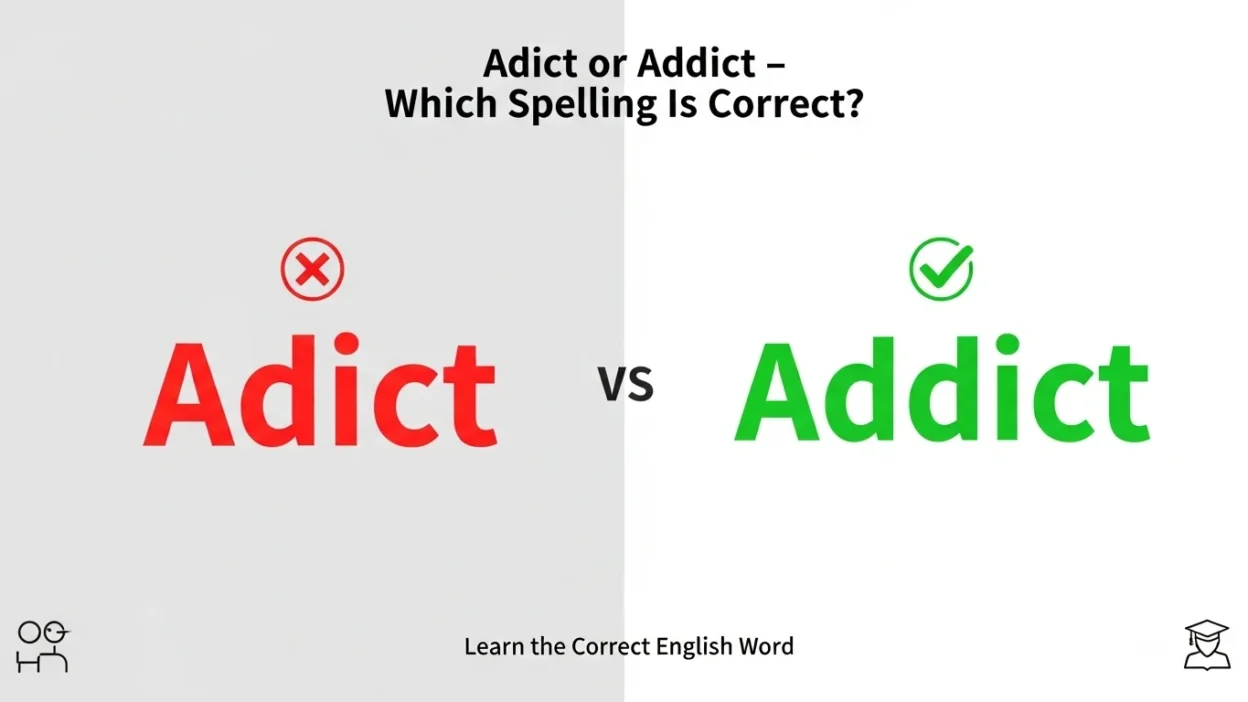
The correct spelling is addict.
- Addict is a real English word.
- Adict is a misspelling and is not recognized in standard English.
Example:
- Correct: He is a gaming addict.
- Incorrect: He is a gaming adict.
If you want to write correctly in English, always use an addict.
What Does “Addict” Mean?
An addict is a person who is strongly dependent on something, often a substance or habit. The word is commonly used in two ways: a serious medical sense and a casual everyday sense.
1. Medical or Serious Meaning
In health contexts, an addict is someone who is dependent on substances such as drugs or alcohol.
Example:
- She is recovering from being a drug addict.
2. Casual or Informal Meaning
In everyday conversation, the word can describe someone who loves something a lot.
Examples:
- I’m a coffee addict.
- He’s a fitness addict.
- She’s a shopping addict.
In these cases, the word simply means someone who enjoys something very strongly.
Why Do People Write “Adict”?
The spelling adict usually appears because of simple typing mistakes or misunderstanding of English spelling rules.
Common reasons include:
- Missing one d
- Typing too fast
- Not knowing the correct spelling
- Autocorrect errors
However, “adict” is not a valid English word, so it should always be corrected to addict.
Adict vs Addict: Comparison Table
| Word | Correct or Incorrect | Meaning | Example |
| Adict | Incorrect | Misspelling | ❌ He is a phone adict |
| Addict | Correct | A person dependent on something | ✅ He is a phone addict |
The table shows clearly that only “addict” should be used in proper writing.
How to Use “Addict” in Sentences
Here are several examples to help you understand how the word is used naturally.
Everyday Examples
- She is a chocolate addict.
- My brother is a video game addict.
- He admits he’s a social media addict.
- I’m a travel addict who loves exploring new places.
More Formal Examples
- The program helps drug addicts recover.
- Many alcohol addicts seek treatment each year.
- Support groups help addicts rebuild their lives.
These examples show that the word works in both casual and serious situations.
Common Mistakes People Make
Many writers make small mistakes when using the word addict. Here are the most common ones.
1. Writing “Adict”
Incorrect:
- I am a coffee adict.
Correct:
- I am a coffee addict.
2. Confusing “Addict” With “Addicted”
The words are related but used differently.
Addict (noun) – a person
Addicted (adjective) – describing someone
Examples:
- He is a gaming addict.
- He is addicted to gaming.
3. Using the Word Too Casually
Sometimes the word addict is used jokingly (like “Netflix addict”), but it’s important to remember that addiction can also be a serious health issue.
Related Words and Phrases
To improve your vocabulary, here are some related words often used with addict.
Common phrases:
- Drug addict
- Alcohol addict
- Gambling addict
- Social media addict
- Coffee addict
- Fitness addict
Related terms:
- Addiction
- Addictive
- Addicted
- Dependency
- Habit
Using these variations helps make your writing more natural and expressive.
American vs British English
Good news: there is no difference between American and British English for this word.
Both varieties use the same spelling:
- American English: addict
- British English: addict
So no matter where you are writing whether in the US, UK, Canada, or Australia the correct spelling remains addict.
Tips to Remember the Correct Spelling
Here are some easy tricks to help you remember the spelling.
1. Think of “Add + Dict”
The word has two D’s.
Add + dict = addict
2. Remember the Word “Addiction”
Since addiction has two d letters, the root word addict also uses two d’s.
3. Use Spell Check
Most modern writing tools will automatically correct adict to addict.
FAQs
1. Is “adict” a real word?
No, adict is not a real English word. It is simply a spelling mistake of an addict.
2. What does “addict” mean?
An addict is a person who is strongly dependent on a substance, activity, or habit.
3. Can “addict” be used casually?
Yes. In everyday language, people often use it informally, like “coffee addict” or “travel addict.”
4. What is the difference between “addict” and “addicted”?
- Addict = noun (person)
- Addicted = adjective (state or condition)
Example:
- She is a shopping addict.
- She is addicted to shopping.
5. Is “addict” the same in British and American English?
Yes, the spelling addict is the same in both British and American English.
6. What is the plural of addict?
The plural form is addicts.
Example:
- Many addicts seek support groups.
7. Can someone be addicted to non-harmful things?
Yes. People sometimes describe themselves as addicted to hobbies or interests such as books, travel, or fitness.
8. Is “addiction” related to “addict”?
Yes. Addiction is the condition or state, while addict refers to the person experiencing it.
Summary
The confusion between adict or addict is a simple spelling issue. The correct and recognized English word is addict, while adict is only a misspelling that should be avoided in writing.
If you are describing someone dependent on substances or simply someone who loves coffee or gaming, the proper spelling remains the same.
Understanding this difference helps improve your writing accuracy and professionalism.
By remembering the double “d” in addict and using examples like coffee addict, gaming addict, or drug addict, you can confidently use the word correctly in both casual and formal contexts.
Actionable takeaway:
Whenever you write this word, quickly check for two “d” letters. If you see adict, correct it immediately to addict to ensure proper English spelling.

Mia Elizabeth is a contributing author at SpellPeak, passionate about thoughtful writing and clear communication. She creates engaging, well-researched content that helps readers learn and connect with ideas easily. Her work emphasizes clarity, creativity, and practical value, supporting meaningful digital experiences and accessible knowledge sharing worldwide.