
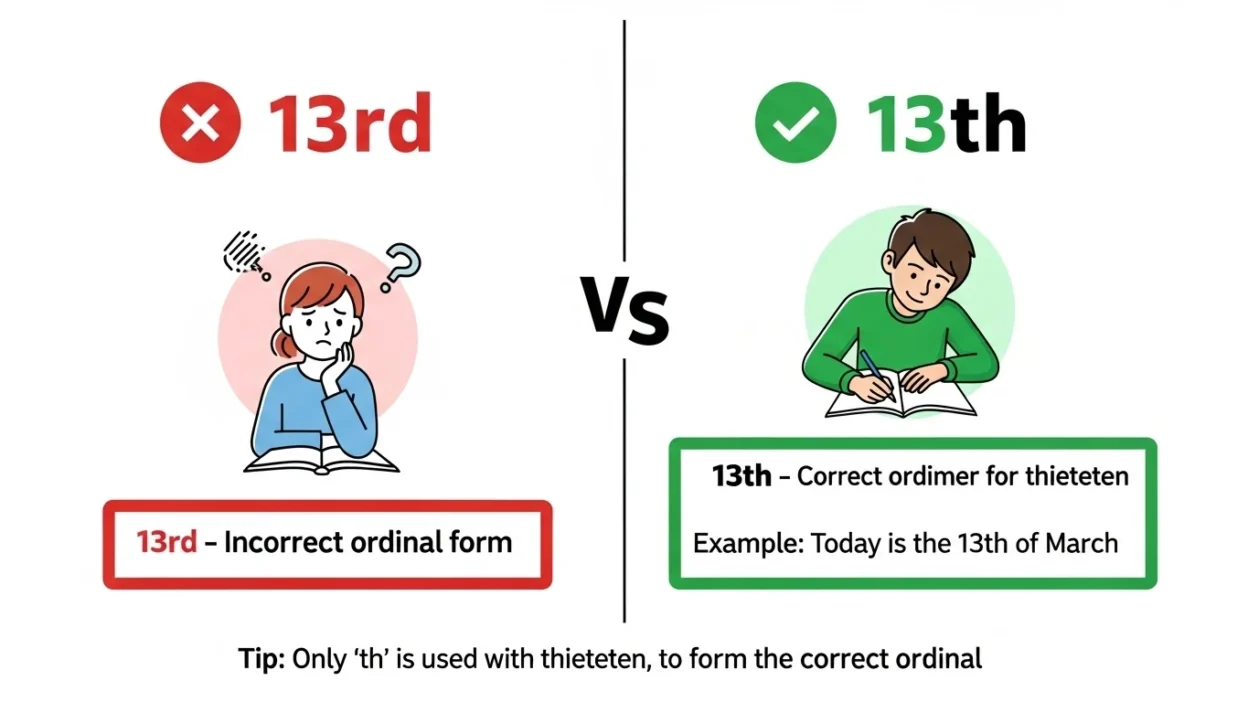
Have you ever seen 13rd written somewhere and wondered if it’s correct or just a typo? You’re not alone. Many people get confused when writing ordinal numbers, especially when numbers end in 3.
This small mistake is very common in English writing, but once you understand the rule, it becomes very easy to avoid.
In this guide, we’ll clearly explain 13rd vs 13th, what each means, which one is correct, and how to remember the rule forever. We’ll also include examples, common mistakes, a comparison table, and FAQs so you never get confused again.
Quick Answer
The correct form is 13th.
13rd is incorrect and should never be used.
The number 13 always takes “th” because numbers ending in 11, 12, and 13 always use th, not st, nd, or rd.
What Do 13rd and 13th Mean?
Ordinal numbers are numbers that show position or order (like 1st, 2nd, 3rd, 4th, etc.).
- 13th = Correct ordinal form of the number 13
- 13rd = Incorrect spelling and grammatical mistake
We use 13th when talking about order, dates, positions, floors, anniversaries, and rankings.
Examples:
- My exam is on the 13th.
- She finished in 13th place.
- His birthday is June 13th.
- This is the 13th chapter of the book.
Why 13rd Is Incorrect
Many people think that because 3 becomes 3rd, then 13 should become 13rd, but English grammar has a special rule.
Here is the rule:
| Number | Correct Ordinal |
| 1 | 1st |
| 2 | 2nd |
| 3 | 3rd |
| 4 | 4th |
| 11 | 11th |
| 12 | 12th |
| 13 | 13th |
Important Rule:
Numbers ending in 11, 12, and 13 always use “th” — not st, nd, or rd.
So:
- 11th ✅
- 12th ✅
- 13th ✅
- 13rd ❌
Examples of 13th in Sentences
Here are real-life examples to help you understand how to use 13th correctly:
- The meeting is on the 13th of March.
- He came 13th in the race.
- We live on the 13th floor.
- Today is my 13th birthday.
- This is the 13th time I told you.
These examples show how ordinal numbers are used in daily English writing and speaking.
Common Mistakes People Make
Here are some common mistakes related to 13rd vs 13th:
- Writing 13rd instead of 13th
- Writing 13th as 13rd in dates
- Confusing ordinal rules for numbers ending in 3
- Thinking all numbers ending in 3 use rd
Wrong vs Correct Examples
| Wrong | Correct |
| 13rd birthday | 13th birthday |
| March 13rd | March 13th |
| He finished 13rd | He finished 13th |
| 13rd floor | 13th floor |
Easy Trick to Remember the Rule
Here is a simple memory trick:
“1, 2, 3 follow special rules… but 11, 12, 13 break the rules.”
So remember:
- 1st, 2nd, 3rd
- BUT → 11th, 12th, 13th
This trick helps you remember forever.
American vs British English
Good news — there is no difference between American and British English for this rule.
Both use:
- 13th ✅
- 13rd ❌
The only small difference is in date writing format:
| American English | British English |
| March 13th | 13th March |
| 03/13/2025 | 13/03/2025 |
But 13th spelling stays the same in both.
Related Ordinal Number Rules
Here are more ordinal number examples to help you understand the pattern:
| Number | Ordinal |
| 3 | 3rd |
| 4 | 4th |
| 10 | 10th |
| 11 | 11th |
| 12 | 12th |
| 13 | 13th |
| 21 | 21st |
| 22 | 22nd |
| 23 | 23rd |
| 24 | 24th |
Notice:
- 21st
- 22nd
- 23rd
- 24th
But: - 11th
- 12th
- 13th (special case)
FAQs
1. Is 13rd ever correct?
No, 13rd is never correct in English. The correct form is always 13th.
2. Why is it 13th and not 13rd?
Because numbers ending in 11, 12, and 13 always use “th” due to English grammar rules.
3. Do all numbers ending in 3 use “rd”?
No. Only numbers like 3, 23, 33, 43 use rd. But 13 is an exception → 13th.
4. How do you write 13th in words?
13th = Thirteenth
5. Is it March 13 or March 13th?
Both are correct, but:
- Formal writing: March 13
- Informal writing: March 13th
6. What is the rule for st, nd, rd, th?
- 1 → st
- 2 → nd
- 3 → rd
- 4–20 → th
- Exception → 11, 12, 13 always th
7. How can I remember ordinal numbers easily?
Remember this pattern:
1st, 2nd, 3rd, 4th… 11th, 12th, 13th… 21st, 22nd, 23rd
Summary
Understanding the difference between 13rd vs 13th is very important for correct English writing. The correct form is 13th, and 13rd is always wrong. This happens because numbers ending in 11, 12, and 13 are special cases and always use “th”.
If you are writing dates, positions, birthdays, floors, or rankings, you should always use 13th. This rule is the same in both American and British English, so you don’t need to worry about regional differences.
Actionable Takeaway
Here’s a simple rule you can remember:
- 1st, 2nd, 3rd
- 11th, 12th, 13th (special rule)
- 21st, 22nd, 23rd
If the number ends in 13 → Always use “th”.
Once you remember this rule, you’ll never write 13rd again.

Noah Jacob is the administrator of SpellPeak, responsible for managing website operations, content coordination, and platform performance. He ensures smooth functionality, security, and reliability while supporting the team in delivering a seamless, user-focused experience and maintaining high standards of quality across the site.